Family Court & Cafcass Lie Detector Test — UK Wide
Falsely accused by an ex-partner during separation proceedings? Cafcass involved? Lost contact with your children over an allegation that did not happen? Our P300 lie detector test gives you an independent written report on specific contested factual claims. £499, same-day available. Not court evidence — but the report can influence Cafcass officers, mediators and your solicitor.
£499
Standard Test
95%
Accuracy
1hr
Report Time
Adults
Only, Never Children
Get the clarity you need Today.
No more guessing, no more sleepless nights. A definitive answer, in a single session.
A real answer, at last
The question that's followed you for months — sometimes years — is resolved in one 90-minute session. Examiner-led, with every limit explained before you book.
In writing, explained to you
A clear written result on the specific questions you were tested on, with the examiner there to explain what it means and what it does not.
Same day, anywhere in the UK
Your report is in your hand within the hour, before you leave the room. Same-day appointments available nationwide.
Family Court Lie Detector Testing in the UK — Honest Service Description
A lie detector test in the UK family court context occupies a very specific niche. Let us be upfront with you about exactly what it does and does not do. UK family courts have consistently declined to admit polygraph or P300 lie detector evidence — the position from Re A and B [2016] EWFC 40 and Re L (No 2) [2015] EWHC 3191 (Fam) is settled. So the question is not whether the report will be entered into evidence. It will not. The question is whether having an independent expert report on specific contested adult-to-adult factual claims can influence the people whose perception of you matters in the proceedings: your Cafcass officer, your mediator, the other parent's solicitor, your own solicitor, your wider family. The honest answer is that it can — not as evidence, but as one piece of credible third-party material in a process where adult-to-adult credibility assessments are otherwise based on conflicting statements. In UK family proceedings the standard of proof is the balance of probabilities, lower than the criminal standard, which means how decision-makers weigh credibility carries real consequences. £499, with same-day appointments if your Cafcass meeting is imminent. We will not test children under any circumstances. We will not take the case if the framing suggests using the test to undermine a genuine child safeguarding concern.
The method matters in family proceedings. A polygraph measures stress responses, and parents facing the loss of contact with their children are under extreme stress, so nerves are a recognised source of error. P300 EEG measures an involuntary recognition response to specific details rather than stress, so it is less dependent on how anxious you are on the day. No method is perfect or immune to deliberate countermeasures, and neither is admitted as evidence in UK family courts.
How the P300 Lie Detector Test Helps in Family Court Disputes
Six honest, concrete ways our family-court clients use the test result. The test is never a substitute for the formal process — it is supplementary objective input on specific contested factual claims between two adults.
Cafcass Officer Credibility Input
Cafcass officers are not bound by court rules of evidence. They consider all available material when assessing adult-to-adult credibility. An independent expert report on a specific contested factual claim is one of the few pieces of independent material in disputes that otherwise come down to word against word.
Mediation Deadlock Breaker
Family mediation is not bound by court rules of evidence at all. Mediators can consider any material both parties agree is relevant. A signed expert report on one parent's account often gives the negotiation enough momentum to resolve.
Solicitor Case Strategy Input
Your solicitor decides how to use the report. Some include it in correspondence with the other side's legal team. Some keep it in the file as a credibility marker. Some use it to test whether their own client's account stands up before taking the case forward.
Your Own Certainty Before Acting
Many parents book the test for themselves first — to know objectively where they stand on the contested facts before deciding their next move. The certainty itself often changes how the situation feels and how it gets handled.
Counter-Allegation Defence
When you raised concerns about the other parent and have since been hit with counter-allegations, the timing alone is suspicious but hard to prove either way. The test on a specific counter-allegation gives your solicitor something objective to point to.
Re-Establishing Contact
Where contact has been suspended over a contested allegation, the test on the specific contested claim can be one piece of input that supports a Cafcass recommendation for resumed or supervised contact. It does not decide the question — but it can move it.
Important: the test is not admitted as evidence in UK family courts and we never claim otherwise. We do not test children. We do not take cases where the test is being used to undermine a genuine child safeguarding concern. We will not provide a report we believe is being misused, and we will discuss every case briefing with you upfront.
Common Family Court Scenarios We See
The four most common contexts where parents and their solicitors instruct the test. Every case is briefed individually — we screen out cases where the test would be inappropriate before we accept the instruction.
Psychological Abuse / Coercive Control Allegation
Allegations notoriously hard to evidence either way. We cannot rebut a pattern — but we can test specific incidents within the pattern. If those specific contested incidents resolve in your favour, that adds weight to your overall account.
Drug or Alcohol Use Claim
Specific claims about substance use, frequency, occasions or behaviour around children. Where the claim is specific and contested, the test gives an objective input that hair-strand testing and self-reporting cannot.
Counter-Allegation Defence
You raised concerns about the other parent and have since been hit with counter-allegations. The timing is suspicious but hard to prove. We test the specific counter-allegation — solicitor gets the report to challenge with.
Mediation Deadlock
Mediator stuck because your account and the other parent's account on a specific factual question are equal weight. The signed expert report on that specific question often gives the mediation enough new input to break the deadlock.
How the Booking Works
Five stages from submitting the booking form to the report landing in your inbox. Same process whether your test is next week or this afternoon.
Fill Out the Booking Form
Submit your details online. Takes under two minutes. No payment until the booking is confirmed by phone.
Assessor Calls You Back
Within minutes an assessor calls to finalise the questions, confirm your location and discuss what the test can do for your specific situation.
Examiner Dispatched
The examiner travels to your private venue in the UK — your home, a hotel room, anywhere private.
Test On Site
The EEG recording takes around twenty minutes, within a 60 to 90 minute appointment including setup and briefing. A lightweight 4-channel EEG headband is all you wear.
Report Within One Hour
The written report is dispatched encrypted to your email within one hour of the test ending. Comprehensive and fully detailed.
Same-day available: Book before 1pm for same-day testing in the UK. Evening tests until 9pm.
What the Test Can and Cannot Do — Honest Version
We will not oversell this. Knowing the limits up front means you book with realistic expectations and use the report effectively.
What the test CAN do
- Provide an independent written report on specific contested adult-to-adult factual claims
- Be considered by Cafcass officers as part of their broader assessment (they are not bound by court rules of evidence)
- Be referenced in family mediation, where rules of evidence do not apply
- Give your solicitor an independent expert report to use as they see fit in case strategy
- Measure recognition rather than stress, so it is less dependent on nerves than a polygraph
- Give you, the tested parent, certainty for your own decision-making
What the test CANNOT do
- Be admitted as evidence in UK family courts — they have consistently declined and continue to decline polygraph and P300 reports
- Determine custody, contact arrangements, or any safeguarding decision — those belong with Cafcass and the court
- Tell anyone you are a good parent — it tests specific contested factual claims, not parenting quality
- Be used on children — we do not test minors under any circumstances
- Override a genuine child safeguarding concern — we will not take the case if that is what is being asked
- Replace your solicitor, your Cafcass officer, or the formal family court process
- Rebut a pattern allegation overall — only specific incidents within it
Why we say this up front: family court is the area where lie detector services are most often oversold. Some providers claim "supports your court case" or "admissible as evidence" — both untrue and potentially damaging to your case if your solicitor relies on them. We tell you exactly what the test can and cannot do, so you and your solicitor make the right decisions about whether and how to use it.
Where We Can Conduct the Test in the UK
The test does not require a clinic. The equipment is portable and the test runs in any private quiet space for around ninety minutes total including setup.
Your Home
Most common venue. Any quiet room with a chair and table works. The kit is professional but unobtrusive.
Hotel Meeting Room
For maximum discretion we regularly use Premier Inn, Holiday Inn, ibis and similar across the UK.
Office or Serviced Room
Your office, a serviced meeting room, or any private business space works for the test.
Anywhere Private in the UK
Serviced apartment, conference centre, private rental. Tell us your situation and we help find a venue.
Pricing — Transparent and Inclusive
No hidden fees. No travel surcharges within mainland UK. The price you see is the total cost of the test, the examiner attendance and the written report.
Booked ahead or same-day
- Full 4-channel P300 EEG test
- Signed independent report
- Examiner attendance UK mainland
- Report dispatched within 1 hour of test
- Encrypted delivery to you or your solicitor
- Same-day if booked before 1pm, evenings until 9pm
Instructed by your solicitor
- Brief sent directly from your solicitor
- Tests turned around within 48 hours of instruction
- Report formatted for solicitor case file
- Solicitor receives a copy alongside you
- Phone briefing with senior examiner if needed
How Our Test Differs From a Polygraph
We use brainwave-based recognition testing rather than a polygraph. The two methods measure different things, which matters when you are facing the loss of contact with your children.
Brainwave Response (Our Test)
A recognition response around 300ms after a detail the brain knows. Involuntary and fast.
Laboratory research reports roughly 80–95% accuracy. Not results from our own testing.
Traditional Polygraph
Stress signals — sweat, heart rate, breathing. Measures arousal rather than recognition.
Research puts single-issue accuracy around 87–89% (APA, 2011). Nerves are a known source of error.
Why This Matters in Family Court Cases
Parents facing the loss of contact with their children are under extreme stress. A polygraph measures stress responses, so nerves are a recognised source of error. Our test measures recognition of specific details rather than stress, which is why it is less dependent on how anxious you feel on the day. Neither method is admitted as evidence in UK family courts.
Published research on the recognition method we use (the P300 concealed information test) reports accuracy of roughly 80 to 95 percent in laboratory studies, with more limited field validation. These are research figures, not results from our own testing. Research on single-issue polygraph testing reports accuracy around 87 to 89 percent (American Polygraph Association, 2011); the US National Academy of Sciences (2003) found polygraph accuracy above chance but well below perfection. No lie detection method is immune to deliberate countermeasures, including P300-based tests (Rosenfeld et al., 2004).
Sources: Farwell & Donchin 1991, P300 neuroscience overview, American Polygraph Association (2011) meta-analytic survey, National Research Council, The Polygraph and Lie Detection (2003), Rosenfeld et al. (2004) on countermeasures to P300-based tests.
Real Family Cases From Our Library
Anonymised real cases involving disputes between adult family members and partners. Some people were cleared and some were not: the test answers the question either way. None of these were court cases. View the full case studies library →
Inheritance Dispute: Elderly Parent Suspects Family Member
£22,000 had been taken from an elderly parent's accounts over 18 months of power of attorney. The test was arranged through a solicitor. The result was deception-indicated, and the family member's use of the power of attorney was confirmed.
Read full case →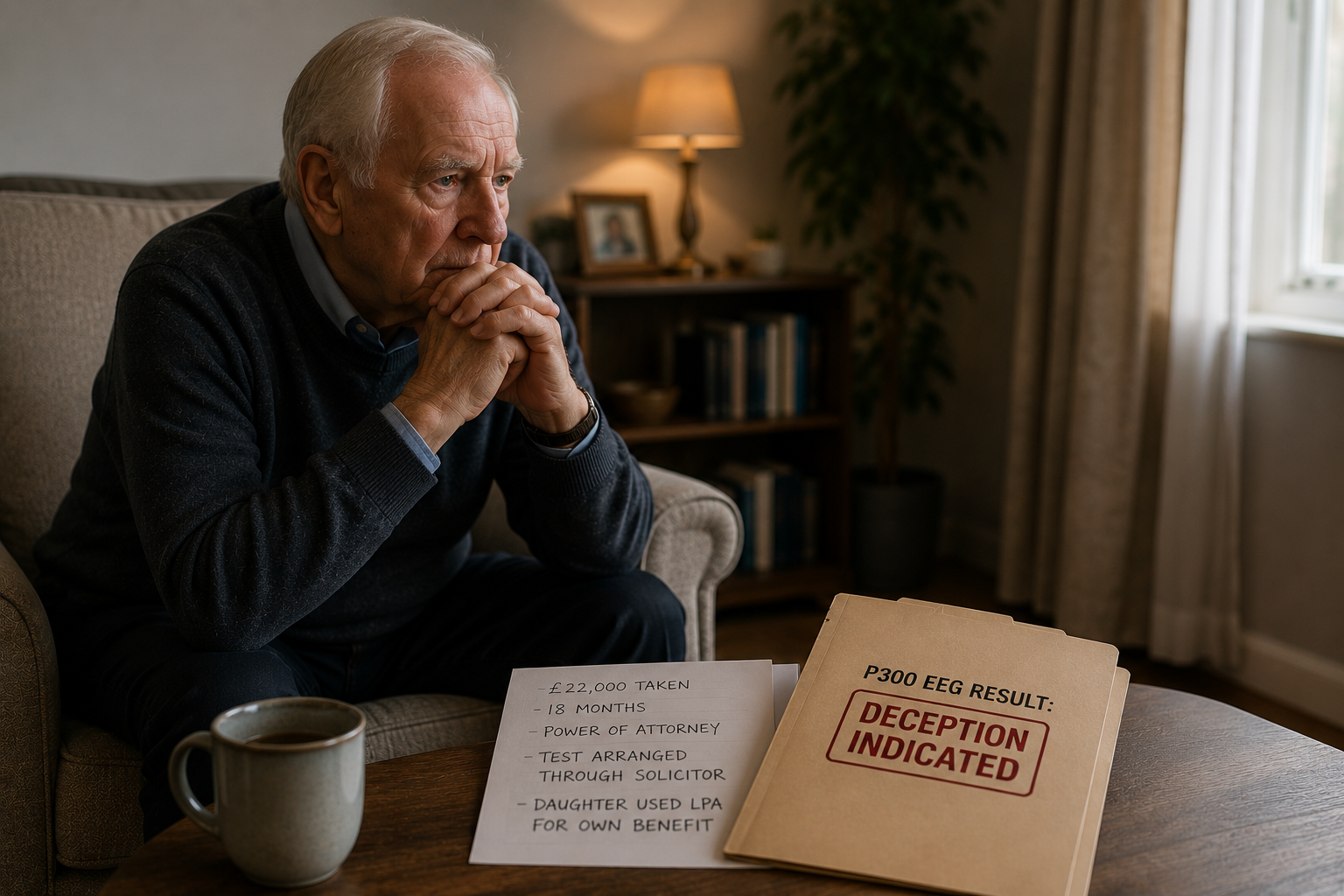
When It Came Back Clear: A Falsely Accused Partner
Tom's partner asked him to show he was telling the truth, and he agreed straight away. All four probe sets came back clear. The case is written from Tom's side: what the experience was like and what the result gave him.
Read full case →Family Business: Three Siblings Tested in One Day
£38,000 went missing from a family building company and three siblings were blaming each other. All three were tested in one day. Two were cleared; one result was deception-indicated. The case study includes the live P300 waveform data.
Read full case →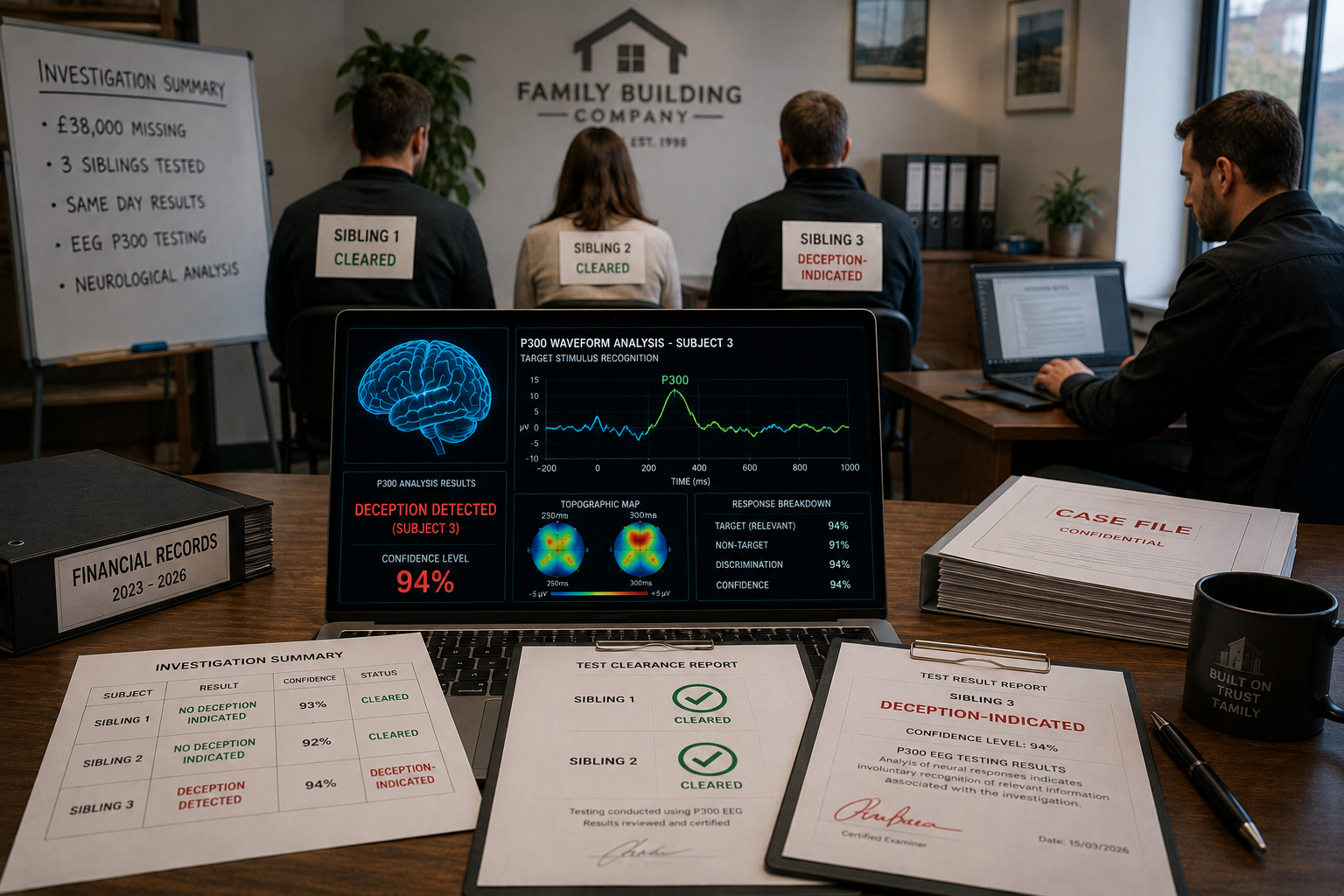
Missing Savings: A Sibling Dispute Resolved
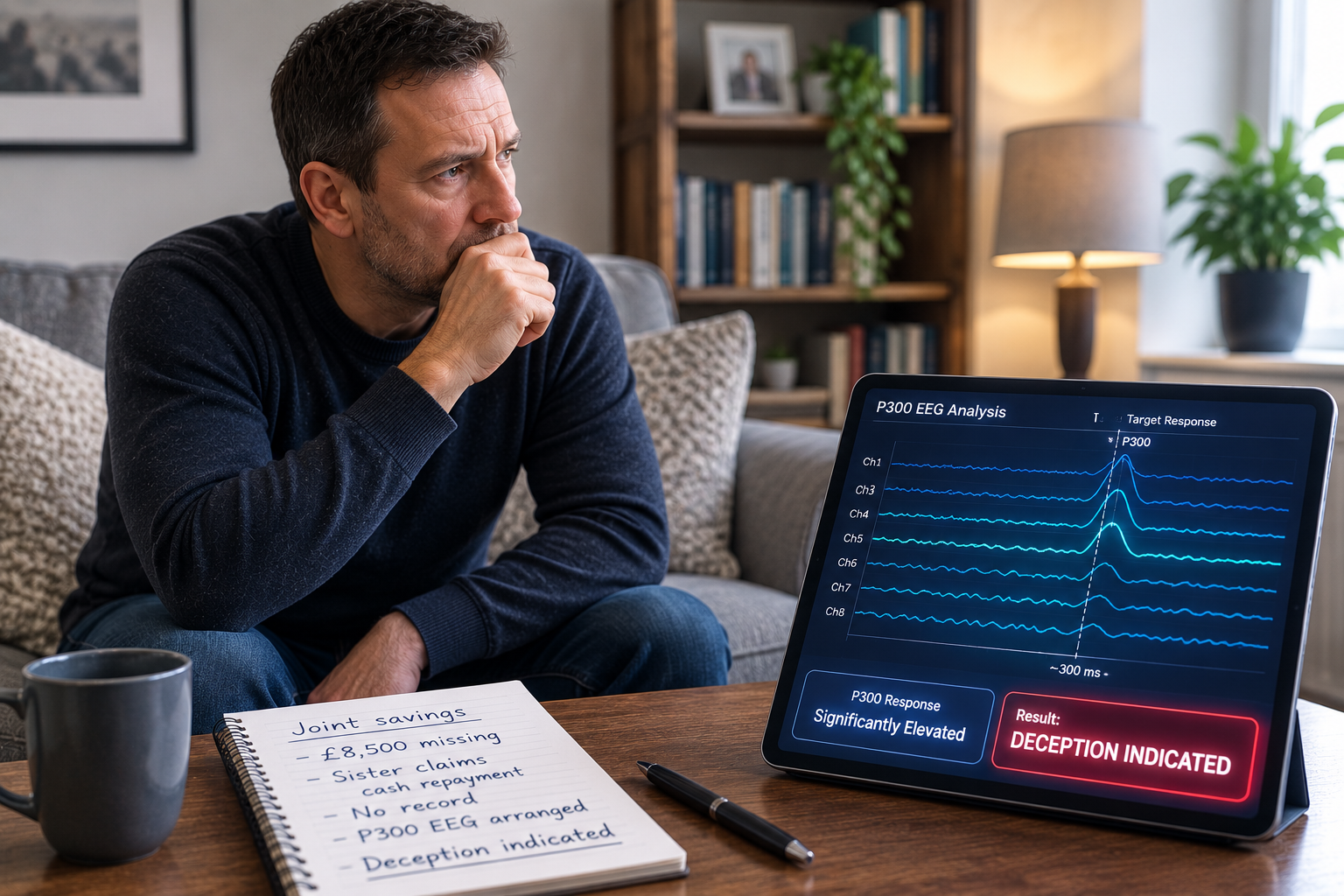
£8,500 had gone from a joint savings account and one sister said she had repaid it in cash. The result was deception-indicated, a reminder that the test answers the question either way. The case study includes the live waveform data.
Read full case →Reviews from Parents and Their Solicitors
Verified reviews from Parents and family-law solicitors who used the test as one piece of input in their case. Aggregate rating 4.9 of 5 from 499 reviews.
Lost contact with my daughter overnight when an allegation was made. Booked the same-day test, took the report to my solicitor. Cafcass noted it. Supervised contact reinstated within four weeks. Without that report I do not know how long it would have taken.
Mediation had stalled for six months over one contested factual claim. Took the P300 test, shared the report through my solicitor. The mediator could finally move the conversation forward. We agreed everything within four weeks. Never went to court.
I refer clients to them when I have a contested factual question that the case turns on and I want an independent expert report to weigh against the other side's account. They are honest about every limit, which is exactly why their reports are credible.
Counter-allegation hit me after I raised concerns about the other parent. Test on the specific incident supported my account. Counter-allegation withdrawn at the pre-hearing review. The original concerns about contact were properly addressed in the substantive hearing.
Earlier polygraph went against me — wrongly, I knew, but I could not prove it. P300 test on the same question was clearly consistent with my account. Solicitor explained the technological distinction to Cafcass. The earlier polygraph was no longer treated as relevant.
Took the test for myself. Months of being told a thing happened that I knew had not happened had me genuinely doubting my own memory. The test gave me certainty back. I used that certainty to engage differently with the rest of the process.
Honest about the limits. They told me explicitly the report would not be entered as evidence in court and that Cafcass would not be bound by it. They were also clear about what it COULD do. That candour was exactly why my solicitor and I trusted them.
We refer clients to DeceptionDetection when polygraph is not the right tool — particularly when our client is highly anxious. P300 EEG works reliably when anxiety is high. The technological distinction matters and the reports we receive are appropriately framed.
Articles on Family Court Cases
Deeper context on how lie detector testing fits into the family court process — Cafcass, mediation, solicitor strategy, and the limits we are honest about up front.
Are Lie Detector Reports Admissible in UK Family Court?
The honest answer is no — and we explain exactly what the report is genuinely useful for outside formal evidence. Cafcass, mediation, solicitor strategy, your own decision-making.
Read article →What Cafcass Officers Actually Do With a Lie Detector Report
Cafcass officers are not bound by court rules of evidence. They can consider any material in producing welfare reports. Here is how the test report fits into their assessment.
Read article →Using a Lie Detector Test to Break a Mediation Deadlock
Mediation has no rules of evidence at all. When both parents' accounts are equal weight, an independent expert report can give the negotiation enough new input to resolve.
Read article →Hit With a Counter-Allegation? Here Is What the Test Can Do
When you raised concerns and have since been hit with timed counter-allegations, the test on the specific counter-allegation gives your solicitor something objective to challenge with.
Read article →Innocent Parents Fail Polygraphs — Why P300 Does Not
Polygraph measures stress. Parents in contact disputes are by definition under extreme stress. That is why innocent parents fail polygraphs. Our brainwave test measures something different.
Read article →How Family Solicitors Use Independent Lie Detector Reports
Some firms instruct on behalf of clients. Some use the test on their own client before taking a case. Some include the report in correspondence with the other side's team.
Read article →Coercive Control Allegations — What the Test Can and Cannot Address
The test cannot rebut a pattern allegation overall. It can test specific incidents within the pattern. Here is how to use it honestly without overpromising.
Read article →Taking the Test for Yourself — When You Just Need to Know
Many parents take the test for their own certainty before deciding what to do. Months of being repeatedly accused can make anyone doubt their own memory. The certainty matters.
Read article →Further Reading
On this site
External authoritative sources
Family Court Lie Detector Test FAQ — the UK
The questions parents and solicitors most often raise at the case briefing. Tap each one to expand.
Is the lie detector test report admissible as evidence in UK family court?
If the report is not admissible, what use is it in family proceedings?
Do you test children?
Would the test help with a child safeguarding concern?
How is P300 EEG different from a polygraph in family court cases?
Will Cafcass take the report into account?
Can the test rebut an allegation of coercive control or psychological abuse?
How quickly can I be tested in the UK if a Cafcass meeting is imminent?
Can my solicitor instruct on my behalf?
Is the test confidential and what happens to my data?
I am too anxious to function — can I still take the test?
What if my ex-partner refuses to take a test themselves?
Speak to a senior examiner about your case before booking. The first call is free, confidential, and we will tell you honestly whether the test is the right tool for your specific situation.
Submit the booking form and an assessor calls within minutes. The first conversation is free and confidential — we will give you an honest assessment of whether the test can help your specific situation before you commit to anything.
Last updated: 25 May 2026