How Does a Polygraph Test Work? The Lie Detector Test Explained Step by Step
A polygraph does not read minds and it does not detect lies directly. Understanding what it actually measures - and how examiners turn those measurements into a result - is the best preparation for anyone considering a lie detector test, whether you are commissioning one or sitting one.
Quick answer: a polygraph continuously records physiological signals - breathing, cardiovascular activity and sweat gland activity - while structured questions are asked, and an examiner infers deception by comparing your responses across different question types. The result is an interpretation of stress patterns, not a direct detection of lies.
By the Deception Detection examiner team · Updated
The Short Version
How a Polygraph Test Works in Five Steps
Pre-test interview The examiner takes a medical and medication history, explains the process, and agrees every test question with you word for word. This is the longest stage, usually 45 minutes to an hour.
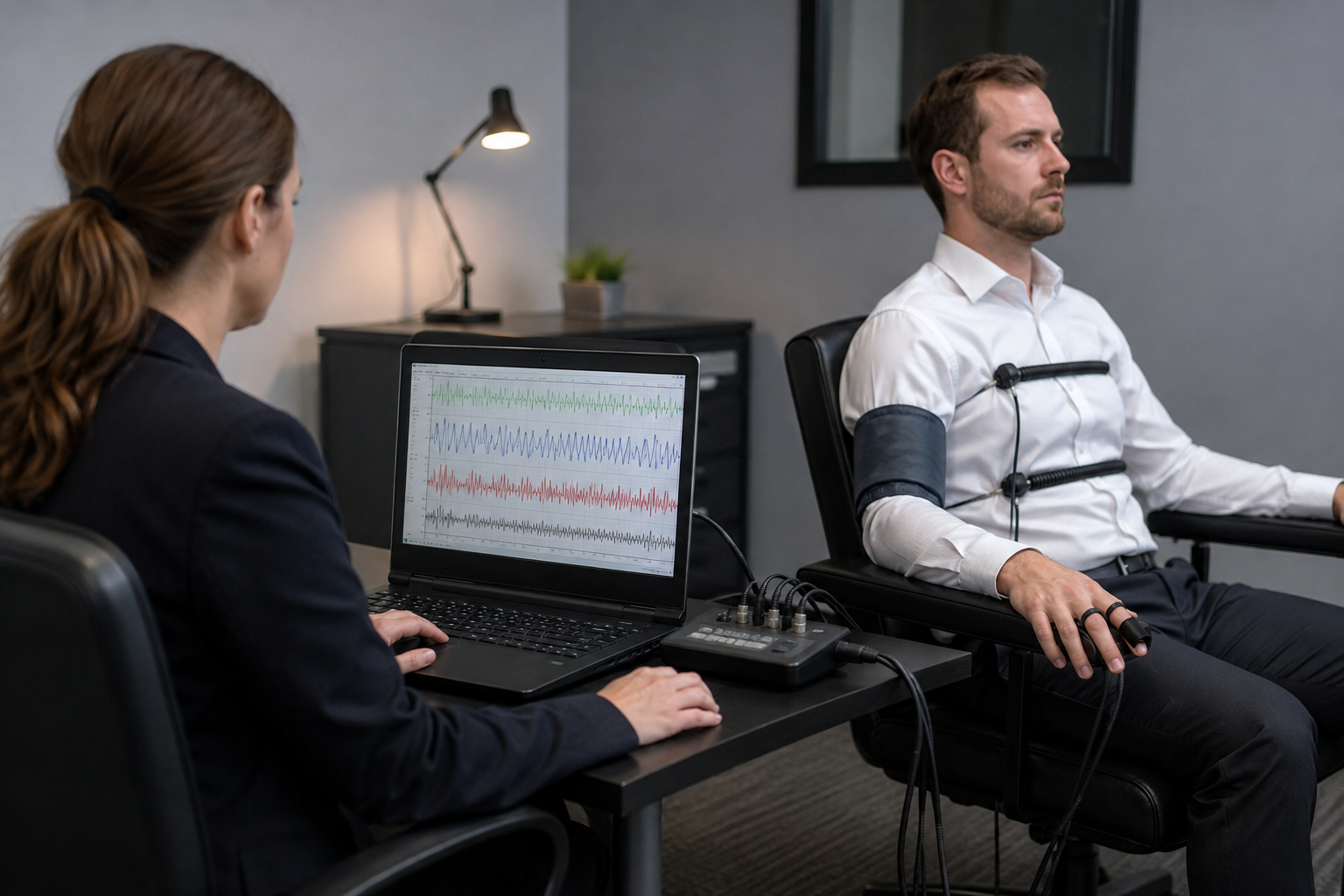
Sensors fitted Two breathing tubes around the chest and abdomen, a blood pressure cuff on the upper arm, electrodes on two fingertips, and usually a movement sensor in the seat.
Questions asked in passes The agreed questions are read out in a controlled sequence, several times over, while the instrument records continuously. Each pass is one chart.
Charts scored Your physiological response to each relevant question is compared against your response to the neighbouring comparison questions, scored numerically, and summed across all charts.
Result and report Totals beyond a threshold read as deception indicated or no deception indicated; totals in the middle are inconclusive. A professional service gives the result verbally and in a written report.
The rest of this page takes each step apart, then explains where the method struggles and what has replaced it.
The Instrument
What the Sensors Actually Measure
A traditional polygraph records several physiological channels simultaneously. Two pneumograph tubes around the chest and abdomen track the rate and depth of breathing. A cardiovascular cuff on the upper arm records relative blood pressure and pulse. Electrodes on the fingertips measure electrodermal activity - how much the sweat glands are firing, which changes the electrical conductance of the skin. Modern instruments usually add a movement sensor in the seat pad, whose job is not lie detection at all but detecting deliberate physical interference with the other readings.
Sensor
Where it goes
What it records
What it is taken to indicate
Pneumograph tubes
Chest and abdomen
Rate and depth of breathing
Breath-holding, shallow or suppressed breathing on a question
Cardio cuff
Upper arm
Relative blood pressure and pulse
Cardiovascular arousal on a question
Electrodermal plates
Two fingertips
Skin conductance from sweat gland activity
The most sensitive arousal channel, and the fastest to react
Movement sensor
Seat pad, sometimes arm rests
Muscle tensing and posture shifts
Not deception: deliberate interference with the other channels
Notice what is on that list and what is not. Every channel is a measure of arousal - the body’s general state of activation. None of them is a measure of deception. There is no physiological signal unique to lying, and no polygraph channel that lights up for falsehood specifically. The entire method rests on an inference: that for most people, in a properly structured test, deception produces more arousal on the questions that matter than truth-telling does.
That inference is the method’s foundation and its permanent vulnerability in one. Arousal accompanies lying, but it also accompanies fear, anger, embarrassment, surprise and the raw experience of being wired to a machine while your relationship or livelihood hangs on the output. Everything else in polygraph technique - the question structures, the comparison logic, the pre-test rituals - exists to manage that ambiguity. Understanding this single point tells you more about the polygraph than any equipment specification.
The Logic
The Comparison Question Technique
The dominant method in professional testing is the Comparison Question Technique. The examiner constructs three types of question. Relevant questions address the issue under investigation directly and specifically. Comparison questions are deliberately broad and uncomfortable probes - typically about general honesty in the subject’s past - designed so that almost everyone responds to them measurably. Neutral questions, such as confirming your name or the day of the week, establish a baseline and give the charts somewhere to rest.
The scoring logic is relative, and this is the part most people have never had explained. The test does not ask whether you reacted to the relevant questions - nearly everyone does. It asks whether you reacted more to the relevant questions than to the comparison questions. The theory holds that a deceptive subject fears the relevant questions most, while a truthful subject - knowing their answers to the relevant questions are safe - is more troubled by the vague, uncomfortable comparison questions. The difference between those two reactions, repeated across several chart collections, is the raw material of the result.
An alternative family of methods, the Concealed Information Test, works on an entirely different principle: instead of probing whether you are lying, it probes whether you recognise details only a person involved in the matter could know - the amount stolen, the room it happened in - hidden among plausible alternatives. It is scientifically better regarded than the comparison method, but it requires case details that can be kept secret, so it suits investigations more than relationship disputes. It is also the logic that recognition-based EEG testing builds on, measured at the brain rather than through stress.
Get Your Own Answer, Professionally Documented
Reading about testing only gets you so far. A professional lie detector test - at home
or a discreet local venue anywhere in the UK, with a written results certificate - gets
you the answer itself. Same-day and next-day appointments available.
Or call us on +44 161 524 5513 to talk it through in confidence first.
The Appointment
What Happens on the Day, Stage by Stage
A professional examination has three stages, and the first is the longest. The pre-test consultation typically runs forty-five minutes to an hour or more: the examiner explains the process, takes a medical and medication history, discusses the issue under investigation, and constructs the questions with you - every question agreed in advance, word for word, because a question the subject finds ambiguous on the day produces an unreadable chart. This stage also settles nerves, which is not a courtesy but a technical requirement: measurement on a panicked subject is measurement of the panic.
The testing phase itself is shorter than most people expect. The sensors are fitted, and the agreed questions are asked in a controlled sequence while the instrument records continuously - typically several passes through the question set, often in varied order, with pauses between charts. The examiner is watching the recordings in real time, noting anything - a cough, a shifted posture, an oddly timed deep breath - that could contaminate a reading.
Afterwards comes scoring and the debrief. The examiner evaluates the charts, reaches a conclusion, and reports it - in a professional service, both verbally and then in a written report that sets out the questions examined, the method used and the finding. Most complete appointments run between one and three hours; our detailed guide to test duration breaks the timeline down further, including how quickly urgent bookings can happen across the UK.
The Verdict
How Charts Become a Result
Traditional scoring is numerical. The examiner compares the physiological response to each relevant question against the adjacent comparison questions across every channel, assigns scores to each pairing, and sums them across all the charts collected. Totals beyond a threshold in one direction support deception indicated; beyond a threshold in the other direction, no deception indicated; and totals in the middle produce the third outcome nobody books a test hoping for - inconclusive.
Computerised scoring algorithms now exist and are widely used alongside hand scoring. They bring consistency - the same charts always score the same way - but they analyse the same stress signals, so they inherit the same foundational ambiguity. An algorithm applied to arousal data is more repeatable than a human, not more able to distinguish fear from guilt.
The honest summary is that a polygraph result is a structured, disciplined interpretation of stress patterns - and interpretation is the operative word. Two trained examiners can read genuinely borderline charts differently. This is why the professional standards matter so much: validated question techniques, published scoring rules, and a written report that shows its working. It is also why you should ask any provider how they handle inconclusive results and whether a retest costs extra, before you book rather than after.
The Real Question
Does a Lie Detector Test Actually Work?
Yes, with a qualification that matters. A disciplined single-issue polygraph, with questions agreed in advance and scored to published standards, identifies deception well above chance, and for most of a century it was the only practical instrument for doing so. That is not nothing: it is why police forces, security agencies and private clients have kept using it. Independent research puts real-world accuracy for a typical examination at roughly 60 to 70%, and practitioner bodies report 85 to 95% for the best-run tests; our accuracy guide explains where each figure comes from.
The qualification is that it works by inference. Every channel in the table above measures arousal, and the method assumes deception produces more of it on the questions that matter. When that assumption holds, the test works. When it does not - because the honest subject is terrified, or the deceptive one is calm and prepared - the test fails in a predictable direction. So the useful answer to "does a lie detector work" is: a stress-based one works often, a recognition-based one works for a different reason and without the same failure mode, and the choice between them is the choice that determines how much your result is worth.
The Limits
Where the Method Struggles
Everything above points to the same three structural limits. First, false positives: the machine cannot distinguish the stress of lying from the stress of being suspected, so anxious but truthful subjects are at documented risk - the full picture is on our page about failing a polygraph through nerves. Second, countermeasures: because the test compares stress levels the subject partly controls, motivated subjects can attempt to distort the comparison, which the research literature treats as a genuine limitation. Third, interpretation: the result is a human reading of ambiguous data, disciplined by protocol but never fully mechanical.
None of this makes the polygraph worthless - a disciplined single-issue examination beats chance comfortably, and for decades it was the only practical instrument available. But the limits explain both why UK criminal courts do not admit the results and why the field has spent thirty years developing methods that measure something the subject cannot consciously influence.
The Next Generation
From Stress to Recognition
The most significant development in lie detection is a change in what gets measured. EEG-based recognition testing records the brain’s electrical activity directly and looks for the involuntary response the brain produces - roughly three hundred milliseconds after a stimulus appears - when it recognises information it has genuinely encountered. Details of the matter under investigation are presented among neutral alternatives; recognition shows in the data whether the subject wants it to or not.
The structural advantages map exactly onto the polygraph’s three limits. Nerves do not create a false recognition signal, so anxious-but-honest subjects are not penalised. The response occurs before conscious control is possible, so the countermeasure surface is dramatically smaller. And the analysis is statistical rather than interpretive - a measurement, not a reading of squiggles. That is the method our service is built on; our full polygraph-versus-EEG comparison sets the two side by side, and the booking page explains exactly what a session involves.
See It in Practice
Case Studies: How These Rules Play Out in Real Situations
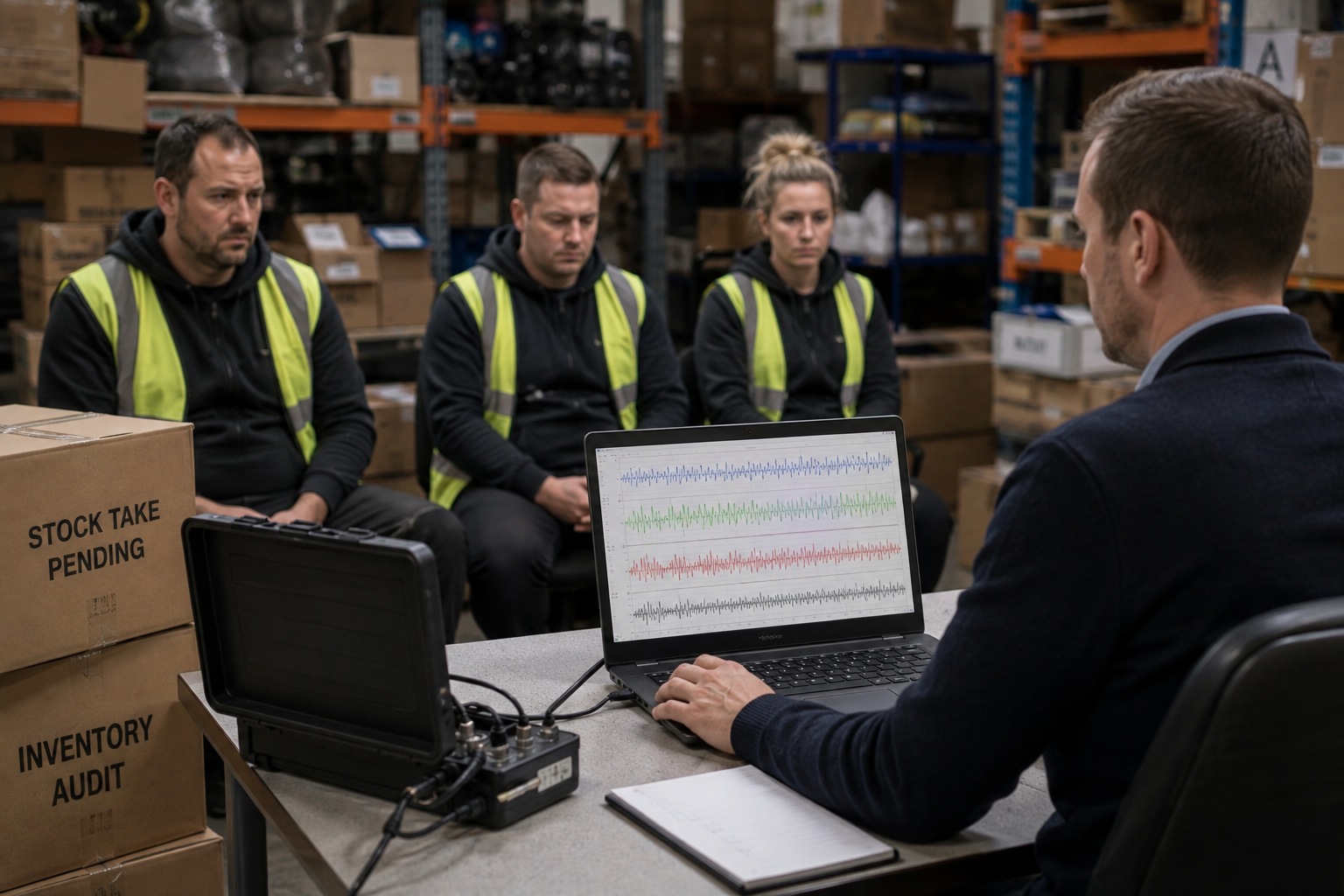
The admissibility rules on this page, applied: voluntary written invitations, HR advice first, and a test used as one strand of a documented investigation - never the verdict. How one employer cleared three staff and found the answer lawfully.
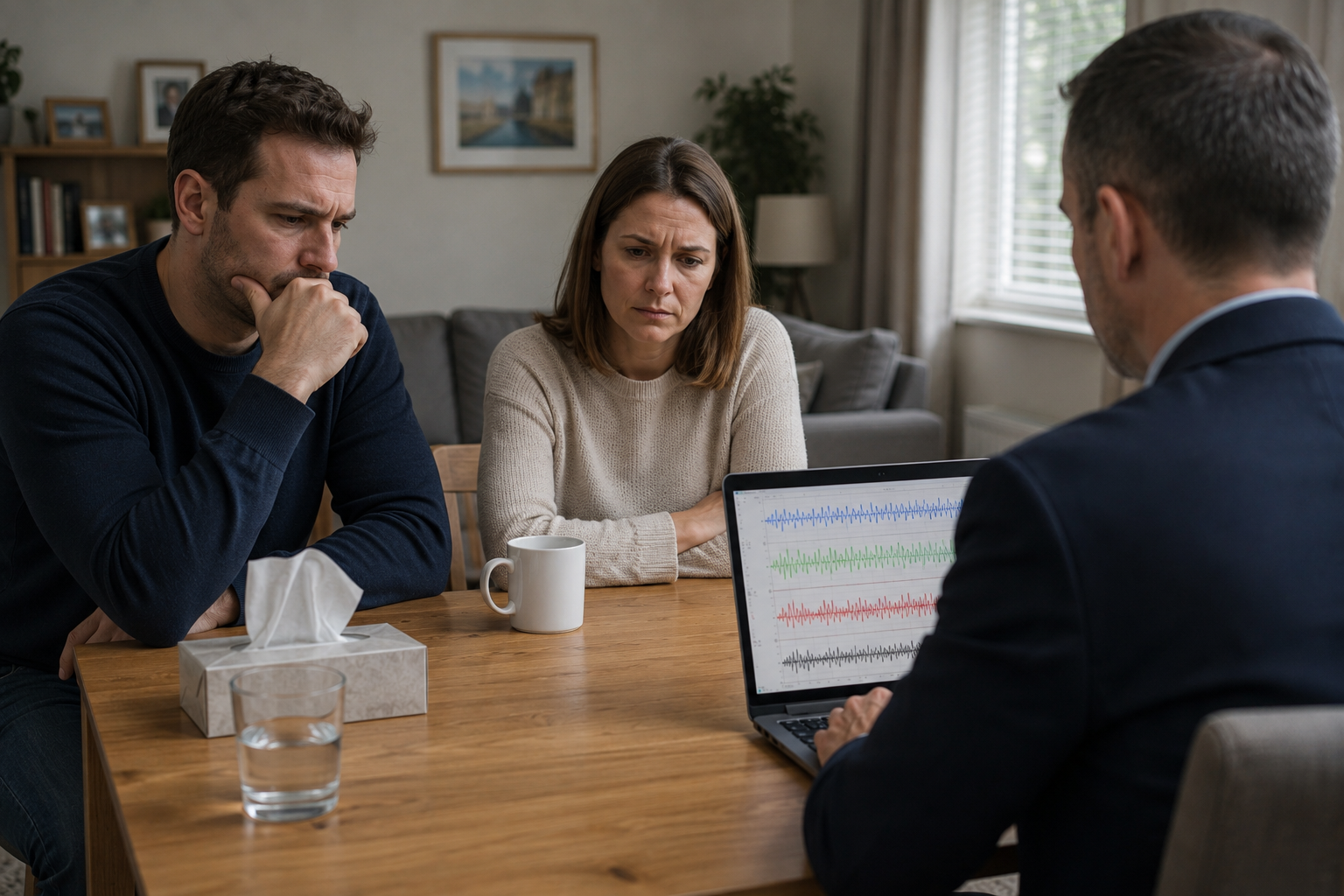
Most private tests are never meant for a courtroom - they are meant to settle a question between two people. How an accused partner volunteered, agreed the questions in advance, and ended a two-month argument in ninety minutes.
When the police cannot attribute shared access and solicitors only harden positions, a symmetrical pair of tests - identical scope, results shared simultaneously - resolved what two years of letters could not.
Short answers to the follow-up questions people ask next.
How does a polygraph test work step by step?
Five steps. A pre-test interview where the examiner takes a history and agrees every question with you word for word. Sensors fitted: breathing tubes, an arm cuff and fingertip electrodes. The agreed questions asked in several passes while the instrument records continuously. The charts scored by comparing your responses to relevant questions against comparison questions. A verbal result and a written report.
Does a lie detector test actually work?
A properly run single-issue polygraph beats chance comfortably, but it works by inferring deception from stress, so it is wrong in a predictable direction: anxious honest people can fail it. Independent reviews put real-world accuracy around 60-70%. Recognition-based EEG lie detector tests measure whether the brain recognises case details instead of stress, which removes that weakness.
What do the polygraph sensors actually detect?
Breathing rate and depth via chest tubes, cardiovascular activity via an arm cuff, and sweat gland activity via fingertip electrodes, usually plus a movement sensor. All of these are arousal signals - the test infers deception from how they change across question types, rather than detecting lies directly.
Are the questions a surprise on the day?
No. In a professional examination every question is discussed and agreed in advance during the pre-test consultation, word for word. Surprise questions would produce unreadable charts and undermine the method itself - a provider who springs questions is a provider to avoid.
What is the difference between relevant and comparison questions?
Relevant questions address the issue under investigation directly. Comparison questions are deliberately broad, uncomfortable probes that almost everyone reacts to. The result comes from comparing your responses to the two types - the test scores the difference, not the reaction itself.
What results can a polygraph test give?
Traditionally three: deception indicated, no deception indicated, or inconclusive. Ask any provider how they handle inconclusive results, whether a retest costs extra, and whether a written report is included, before you book.
How is a lie detector test scored?
The examiner numerically compares responses to each relevant question against adjacent comparison questions across all channels and charts, summing scores against published thresholds. Computer algorithms are often used alongside hand scoring for consistency, but they analyse the same stress data.
Is the test physically uncomfortable?
Not significantly. The cardio cuff is inflated during chart collection and can feel tight, and sitting still matters, but nothing is invasive or painful. Recognition-based EEG testing is lighter still - surface sensors and a screen, with no cuff and no stress monitoring at all.
How does EEG lie detection differ from a polygraph?
A polygraph infers deception from stress signals the subject partly controls. EEG recognition testing measures an involuntary brain response to recognised information, occurring before conscious control is possible. Our full comparison page covers accuracy, nerves, countermeasures and practicalities side by side.
Stop Researching. Get Your Answer.
You have the facts - what you came for is the answer to your own situation. Professional
lie detector testing across the whole of the UK, with same-day and next-day appointments
and a written results certificate with every test.