Deception Detection in Guildford — Professional P300 EEG Testing
Professional deception detection using P300 EEG brain-wave technology — 95% accuracy, same-day results, from £499. Serving Guildford and the wider Surrey area.
Why People Come To Us
Stop wondering, Doubt ends here.
The clarity you came for. The truth, in 30 minutes.
Doubt ends here.
The question you've been carrying for months — sometimes years — ends in a single 90-minute session. No more wondering.
The clarity you came for.
A clear, written, defensible result. No "inconclusive", no grey areas — just a definitive answer you can actually act on.
The truth, in 30 minutes.
Your written report is in your hand the same hour the headband comes off. Same-day appointments available across the UK.
What Is Deception Detection?
Deception detection is the process of determining whether someone is being truthful — using science, not guesswork.
When someone lies, their body and brain respond in measurable ways. For over a century, polygraph machines tried to catch those responses by tracking heart rate, blood pressure, and sweating. The problem is those signals are triggered by stress and anxiety — not deception itself. A nervous truthful person fails. A calm liar passes.
Modern deception detection takes a fundamentally different approach. Instead of measuring stress, our P300 EEG system measures what your brain recognises. When your brain encounters information it already knows — a name, a place, a detail from an event — it produces an involuntary electrical spike. You cannot suppress it, fake it, or train it away. That's what makes P300 EEG deception detection 95% accurate, compared to roughly 65–70% for a traditional polygraph.
We provide professional deception detection across Guildford and the wider Surrey area for relationships, family disputes, workplace accusations, corporate investigations, and legal matters. Testing is non-invasive, takes around 90 minutes, and starts from £499. We travel to you or you can visit one of our testing venues.
How the P300 Brain Response Detects Deception
The P300 is a specific electrical signal your brain produces when it recognises something it already knows. Here's exactly how we use it.
The P300 Response — What It Is
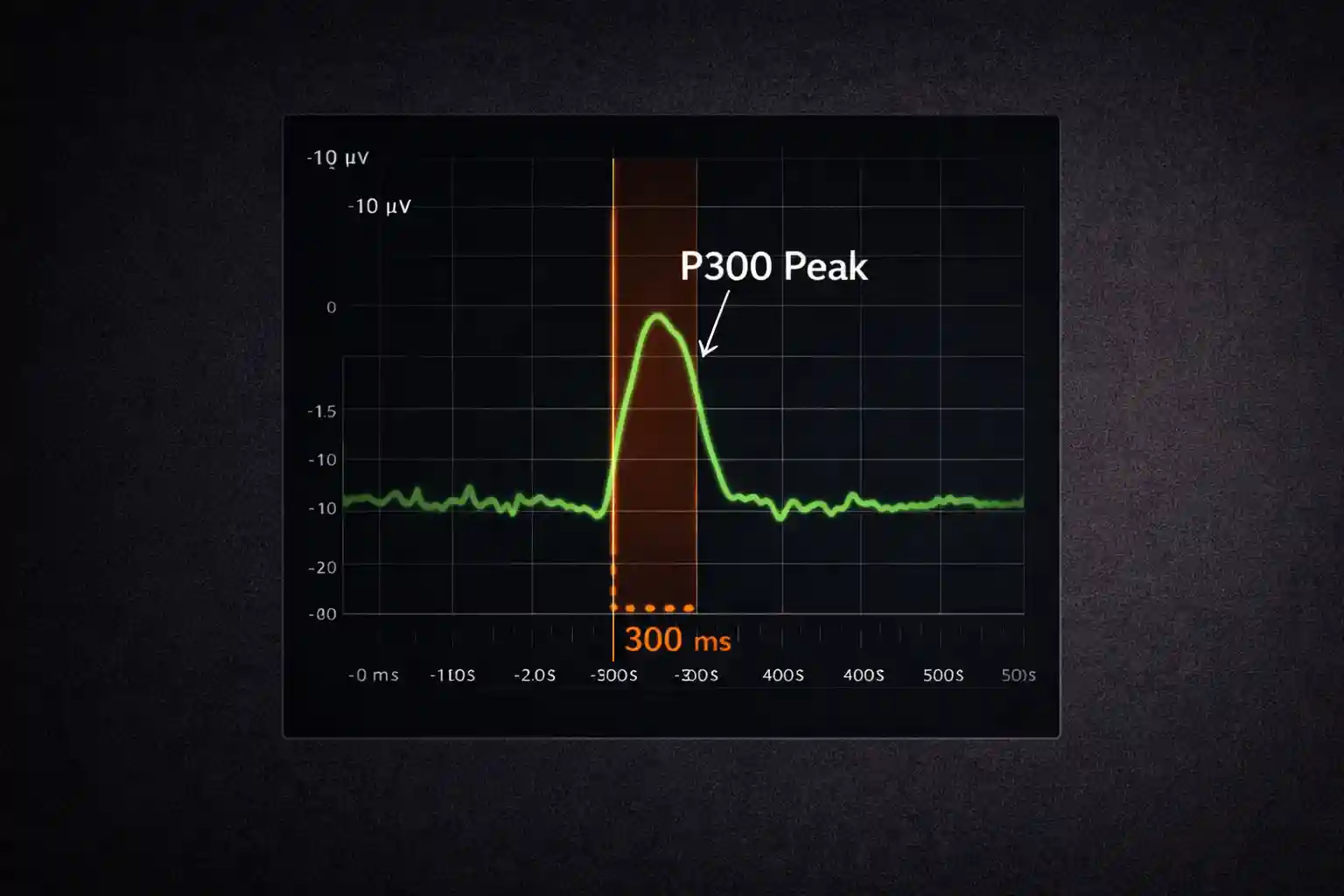
Roughly 300 milliseconds after your brain sees a stimulus it recognises, it produces a measurable spike of electrical activity called the P300 event-related potential. This was first documented in peer-reviewed neuroscience research in the 1960s and has been studied extensively ever since. The P300 is completely involuntary — it happens before conscious thought. Your brain fires it whether you want it to or not.
What Happens During the Test
You wear a lightweight BrainBit EEG headband that sits on your forehead and behind your ears — no wires, no straps, no chest sensors. You sit in front of a screen and are shown a series of words, images, or statements. Some are relevant to the case. Some are irrelevant controls. All you do is watch.
Our 8-channel EEG system records your brain's response to each stimulus in real time. When your brain recognises something relevant — a person's name, a location, a detail you claim not to know — the P300 spike appears across multiple channels. When the stimulus means nothing to you, the signal stays flat. That recognition vs no-recognition pattern is what determines the result.
Why It Cannot Be Beaten
Polygraph countermeasures work because they target voluntary body responses — you can control your breathing, clench your toes, or bite your tongue to disrupt readings. The P300 response is neurological and involuntary. There is no muscle to clench, no breathing pattern to change, and no mental technique that suppresses it. Published research by Farwell & Donchin (1991) and Rosenfeld et al. (2008) consistently shows detection rates between 90% and 98% in controlled blind testing.
What You Receive Afterwards
Within the hour of testing, you receive a detailed 8-page forensic report covering the raw EEG data, P300 spike analysis for each question, deception scoring, and a clear truthful or deceptive determination. The report is suitable for solicitors, employers, HR departments, or personal use. Expert testimony is available on request.
P300 EEG Accuracy Comparison
Independent research consistently shows P300 EEG brain-wave analysis outperforms traditional polygraph
across every key measure. Here's how the two methods compare for clients in Guildford.
P300 EEG measures an involuntary brain response directly. A polygraph measures stress and asks an examiner to interpret it — which is why the two produce different kinds of finding.
✓
No Countermeasures
Polygraph results can be manipulated with breathing or muscle techniques. P300 brain-wave responses cannot be consciously controlled.
✓
Lower Stress
No chest straps, blood pressure cuffs or finger sensors. Just a lightweight headband — making results in Guildford more reliable and comfortable.
What the Readings Actually Look Like
The P300 brain-wave spike is a single, unmistakable response. Polygraph produces four
overlapping signals full of noise. See why P300 EEG results in Guildford are so
much clearer to read and harder to dispute.
P300 EEG — Brain Wave Response
✓ One clear spike — unambiguous result
Polygraph — 4 Overlapping Signals
✗ Noisy, subjective, open to interpretation
Illustrative waveforms based on published EEG and polygraph signal characteristics.
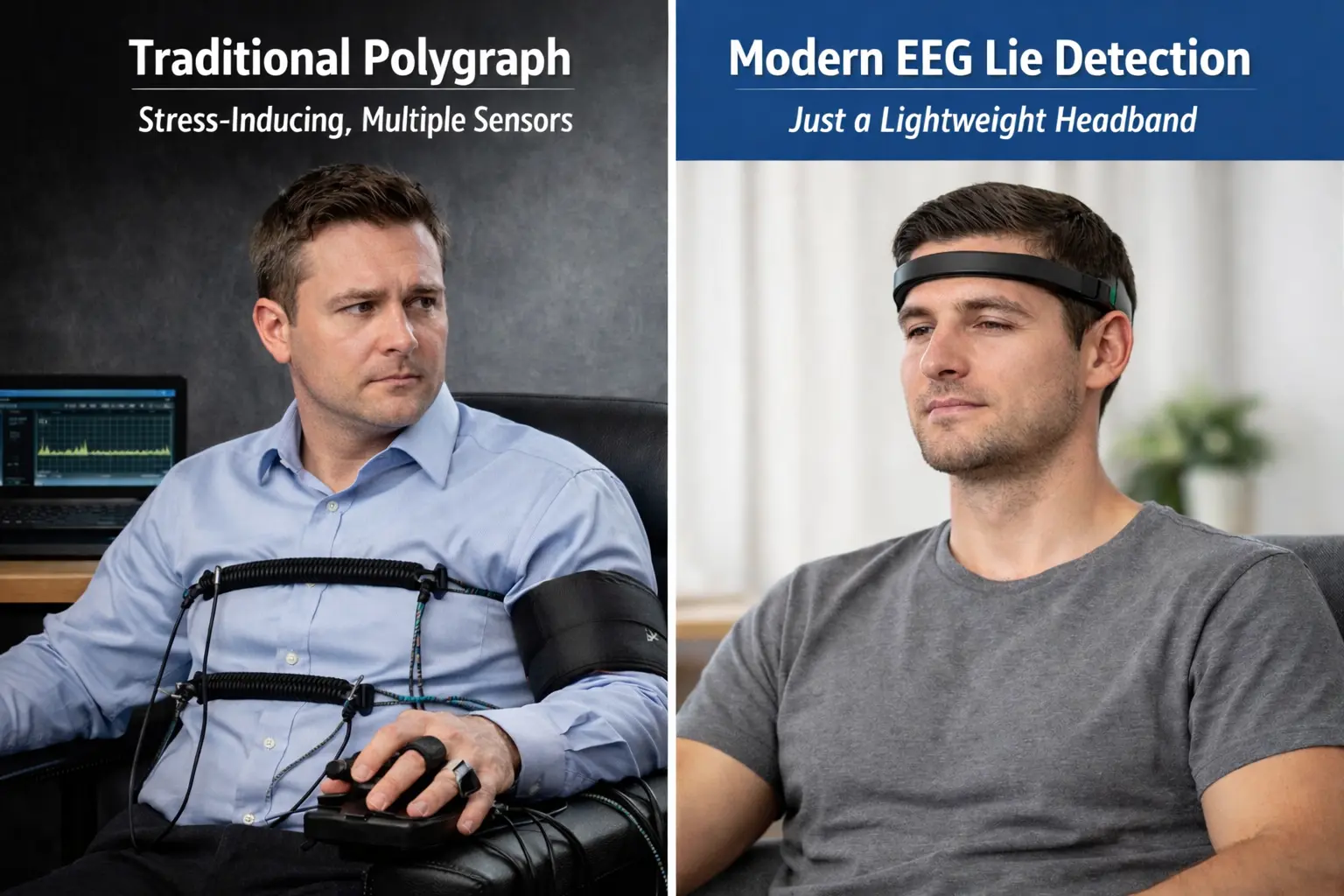
No Wires. No Straps. Just a Headband.
A traditional polygraph straps sensors to your chest, fingers, and arm —
measuring sweat, breathing, and blood pressure while you sit in stress.
Our P300 EEG test uses a single lightweight headband that reads brain activity directly.
No discomfort, no intimidation, and it's over in under 90 minutes.
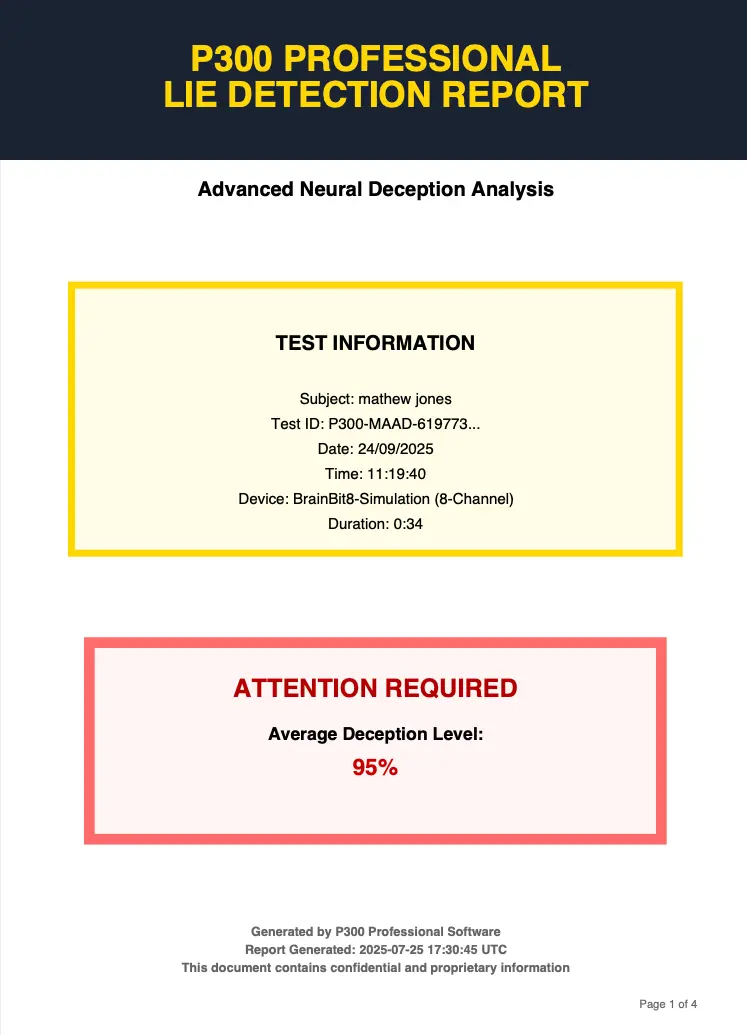
Every P300 EEG test includes a detailed 8-page forensic report — covering raw brain-wave data,
P300 spike analysis, and a clear truthful or deceptive determination. Delivered within the hour.
Swipe through example pages below.
Deception Score Analysis
Granular breakdown of deception scores calculated from specific neural biomarkers.
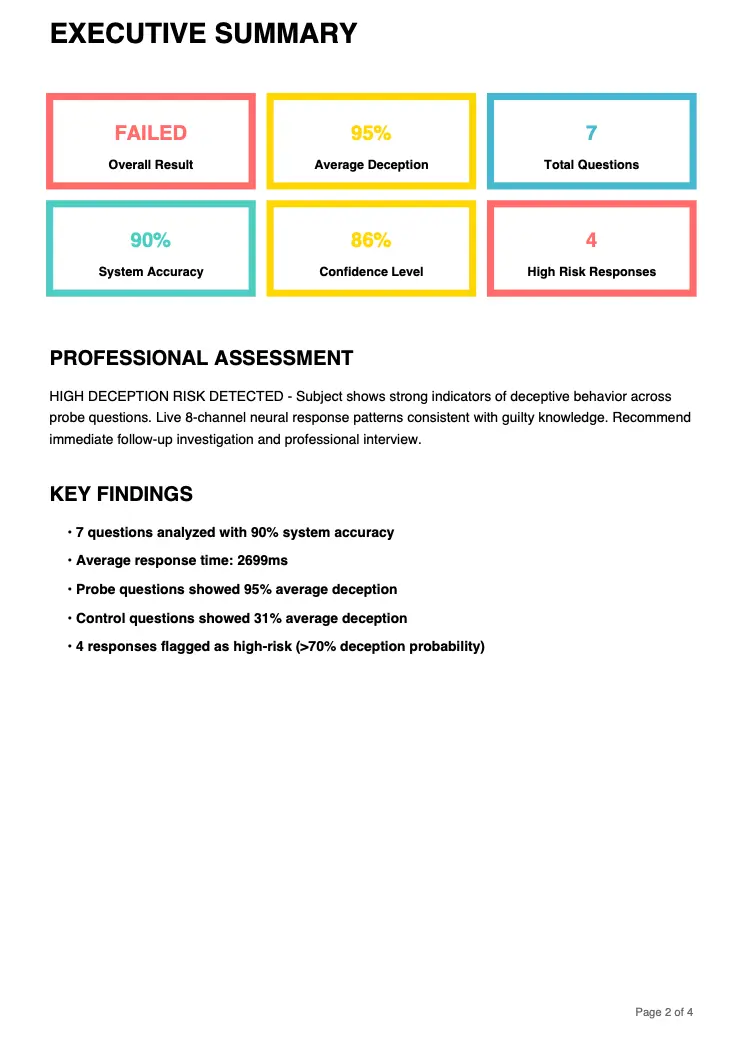
Executive Summary
Clear, definitive results indicating deception probability and overall risk assessment.
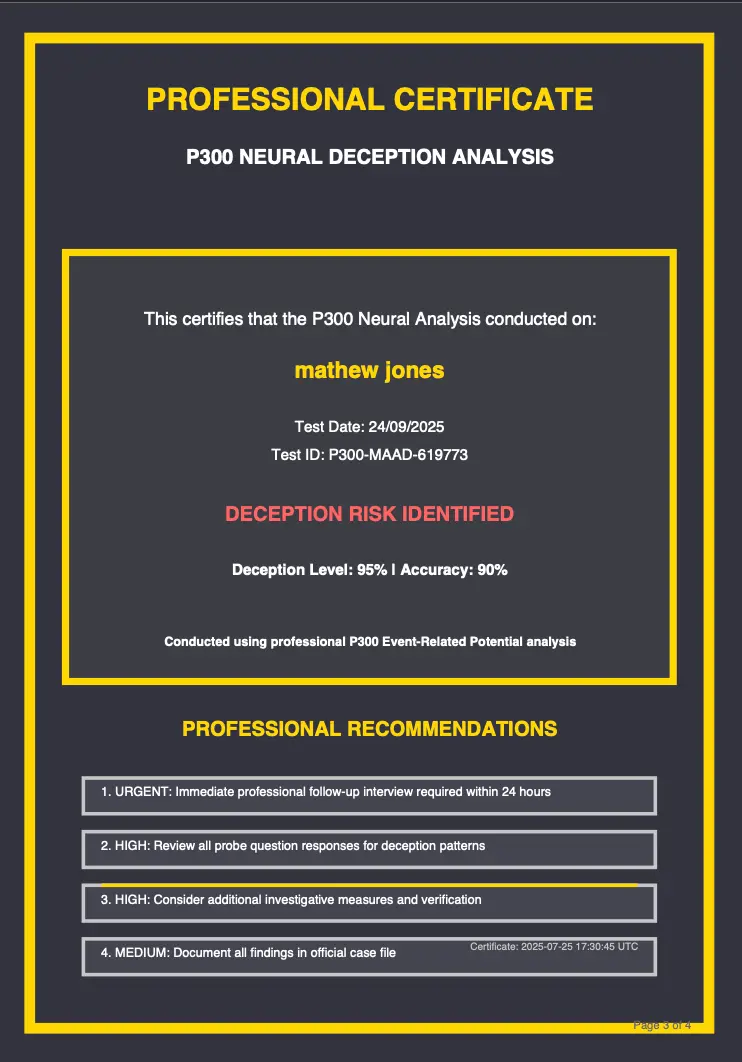
Official Certificate
Signed certification of examination suitable for legal or private verification purposes.
Raw Data Export
Full transparency with access to the raw visual data used to generate the final conclusion.
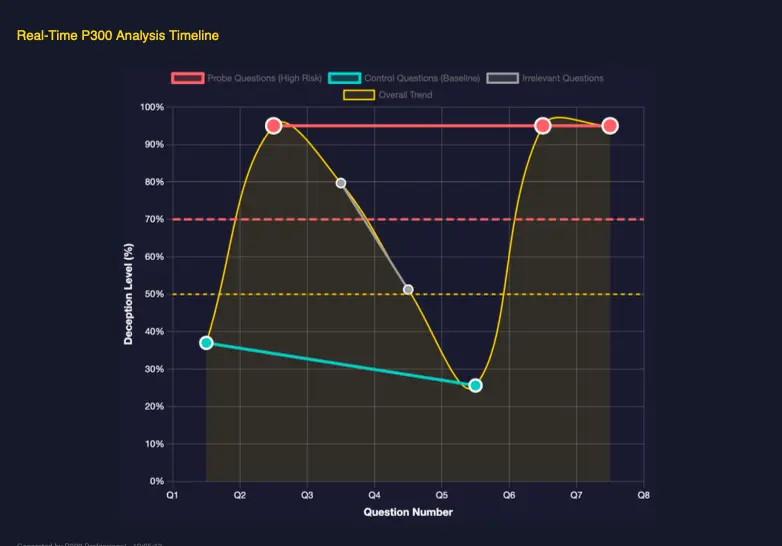
Neural Response Timeline
Millisecond-by-millisecond timeline of brain activity in response to probe stimuli.
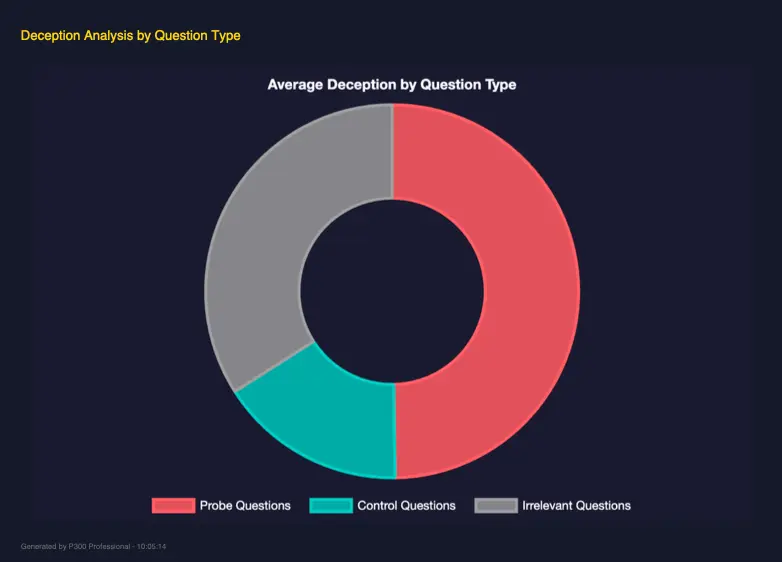
Question Category Breakdown
Comparative analysis of responses to relevant, irrelevant, and control questions.
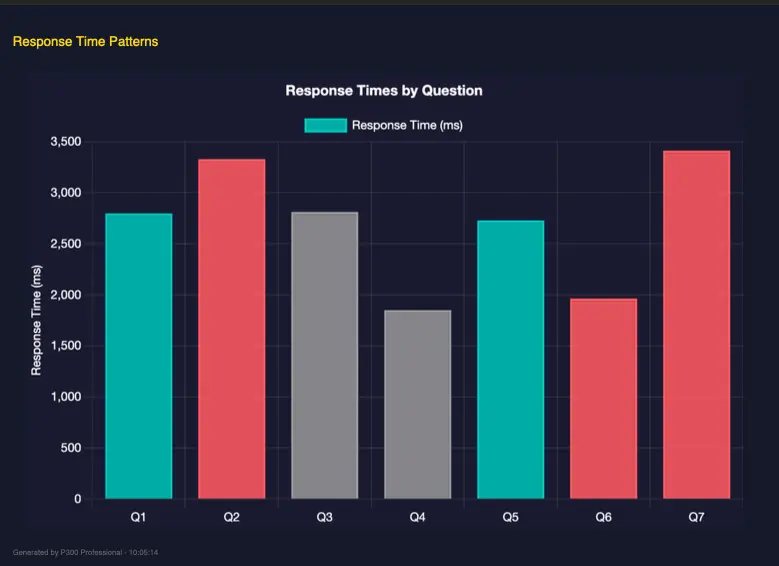
Cognitive Load Metrics
Analysis of response latency indicating increased cognitive load during deceptive answers.
Component Amplitude Data
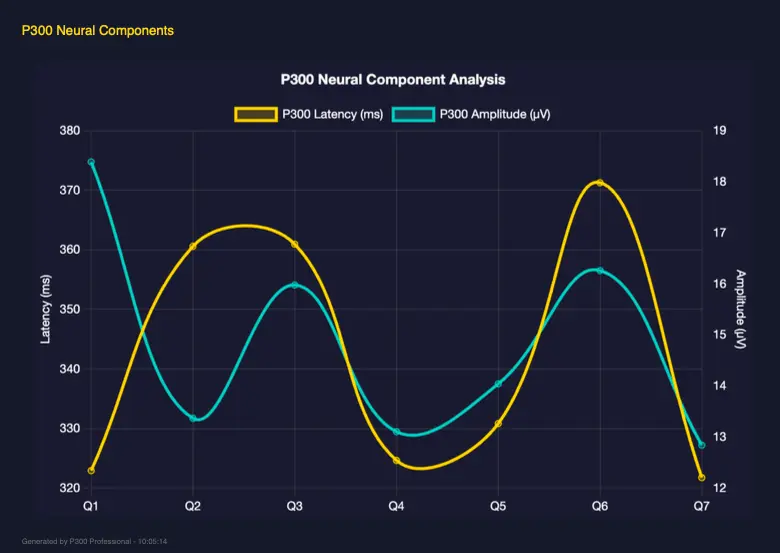
Scientific validation of P300 wave amplitude and latency specific to the subject.
Swipe to view report pages
Home, Office & Safe Place Deception Detection in Guildford, Surrey
We understand that visiting a testing centre is not right for everyone. That’s why we offer fully mobile
P300 deception detection testing at your home, workplace or chosen safe location in Guildford and across Surrey.
Home Deception Detection Testing
Our examiners can travel discreetly to your home in Guildford or elsewhere in Surrey and
set up the P300 EEG equipment in a quiet room. This is ideal for relationship issues, family
disputes and highly sensitive personal matters.
Discreet arrival and departure in Guildford and surrounding Surrey areas
No travel or waiting rooms required for local clients
Comfortable, familiar environment for Guildford households
Same scientific accuracy as our dedicated facilities across Surrey
Safe Places & Neutral Venues
If home or office is not suitable, we can arrange a neutral “safe place” such as a private meeting
room or hotel suite in Guildford or elsewhere in Surrey. This keeps all parties
comfortable and protected.
Neutral locations for sensitive cases across Surrey
Ideal for couples or workplace matters in Guildford
Fully private and confidential environments
Arranged and confirmed in advance for your chosen Surrey location
On-Site Corporate Testing
For businesses, we bring the deception detection system directly to your Guildford or Surrey
office or warehouse, minimising disruption while providing clear, objective findings.
On-site testing for staff and contractors across Surrey
Flexible scheduling around Guildford and regional operations
Discreet handling of investigations for local and regional teams
Corporate deception detection in Guildford, Surrey
Protect your Guildford and wider Surrey business interests with professional P300 EEG deception
detection. Advanced screening for employees, fraud investigation, and corporate security.
Comprehensive deception detection services for Guildford and Surrey businesses. Our
P300 EEG technology provides reliable screening and investigation services to protect your company
from fraud, theft, and misconduct across the region.
Pre-employment deception detection screening in Guildford and across Surrey
Internal fraud and embezzlement investigations for regional operations
Employee theft detection with P300 EEG analysis in Guildford
Workplace misconduct and harassment cases across Surrey
Corporate espionage and data breach investigations for Surrey companies
Supplier and contractor integrity verification in Guildford and surrounding areas
Insurance claim fraud detection for Guildford and Surrey businesses
Disciplinary hearing support with scientific evidence for HR teams
Periodic security screening programs across your Surrey sites
Executive-level deception detection services for Guildford leadership teams
Corporate Packages
Volume testing from £399/person • Annual contracts available • On-site testing in Guildford
and across Surrey
Corporate Benefits for Guildford & Surrey:
Reduce fraud losses with accurate deception detection across Surrey
Protect Guildford business intellectual property and sensitive data
Ensure trustworthy hiring decisions for regional offices
Resolve workplace disputes objectively in Guildford and beyond
Compliance with UK employment law and local Surrey policies
Confidential executive reports for board and HR decision-makers
Multi-subject testing efficiency for large Surrey workforces
Legal support and expert testimony for corporate cases
Custom testing protocols for your Surrey industry sector
Clear ROI through fraud prevention and risk reduction
Private Deception Detection in Guildford, Surrey
Confidential lie detector testing for personal matters in Guildford and across Surrey.
Relationship issues, family disputes, and private investigations with complete discretion.
Personal Deception Detection Services
Private deception detection services for Guildford residents and the wider Surrey community
seeking truth in personal matters. Our sensitive approach and advanced P300 EEG technology provide
clarity in difficult situations.
Infidelity and relationship deception detection in Guildford and across Surrey
Family theft and financial dispute resolution for local households
Child custody and parental fitness verification in Surrey
Dating fraud and online deception detection for Guildford residents
Inheritance and will dispute investigations in Guildford/Surrey
Domestic staff screening and verification across Surrey
Personal safety and threat assessment in and around Guildford
Addiction and substance abuse verification for families in Surrey
Trust rebuilding in Guildford relationships and wider Surrey communities
Anonymous testing options available for sensitive Surrey cases
Private Testing
Individual tests from £499 • Couples testing £799 • Payment plans available for Guildford
and Surrey residents
Private Testing Features:
100% confidential deception detection service for Guildford and Surrey
Comfortable private testing rooms in Guildford
Experienced counsellors available for local clients
Same-day results and analysis where scheduling allows
Home visit options for Guildford and nearby Surrey areas
Relationship counselling referrals across Surrey
Legal documentation support for solicitors
Follow-up testing packages for ongoing Guildford/Surrey cases
Emotional support throughout the process
Flexible scheduling including evenings and weekends
Who Uses Deception Detection Services in Guildford, Surrey?
Our P300 deception detection tests support individuals, couples, families, businesses and legal professionals
across Guildford and the wider Surrey region.
Individuals & Families
Many people in Guildford and throughout Surrey come to us when they need to clear their
name or confirm the truth in difficult family situations. Our approach is calm, respectful and
completely confidential.
People facing false accusations in Guildford/Surrey
Families dealing with theft or dishonesty at home
Parents wanting clarity around child-related issues across Surrey
Partners trying to rebuild trust after alleged infidelity in Guildford
Businesses & Legal Professionals
Guildford and Surrey companies, HR teams, solicitors and investigators use our deception
detection tests as part of broader decision-making and evidence gathering.
HR departments conducting internal investigations across Surrey
Law firms needing additional scientific evidence for local and regional cases
Insurance and financial services providers operating in Guildford and beyond
Security-sensitive employers and contractors throughout Surrey
Deception Detection Coverage: Guildford
Our mobile P300 EEG units cover all of Guildford and beyond, serving the entire region.
When you search for deception detection or lie detector tests in Guildford or across Surrey,
you need a provider you can genuinely trust.
Advanced Technology & Expertise
Specialists in P300 EEG deception detection – not generalists
Experienced examiners familiar with complex Surrey cases
Clear, non-technical explanations of your results for Guildford and regional clients
Local, Flexible & Confidential
Based in Guildford with full mobile coverage across Surrey
Home, office and safe-place testing options throughout Surrey
Evening and weekend appointments available for busy Guildford/Surrey clients
Strict confidentiality and GDPR-compliant handling for all cases
Build Your Test Questions
Tell us your situation in plain English. Our AI will generate 3 professionally worded
yes/no questions — ready to use in your P300 EEG test in Guildford.
0/600
Analysing your situation and building questions...
Here are your 3 suggested P300 test questions for Guildford:
These questions are ready to use. Book your test in Guildford and we'll confirm and finalise them with you before the session.
Your situation is not stored or logged. This tool uses AI to suggest questions only — final questions are always confirmed with your examiner before testing.
🎬 HOW IT WORKS
Deception detection in Action
Watch how our brain-wave technology reveals the truth about infidelity with 95% accuracy
A snapshot of how individuals, families and organisations across the UK
describe their experience with our deception detection service.
Scroll sideways to browse more reviews.
★★★★
Complex Multi-Party Dispute - UK
“Several different people were tested in a multi-party dispute. The team managed the logistics, kept everyone separate where needed and delivered a clear set of reports for our legal conference.” — Senior Partner - Law Firm
★★★★★
Infidelity Case - Manchester
“I booked a P300 EEG test because I suspected my partner was having an affair. The process was professional, calm and clearly explained. The report confirmed what I needed to know and helped me make decisions with evidence rather than just suspicion.” — S. Williams - Private Client
★★★★★
Corporate Investigation - London
“We used Deception Detection UK for an internal fraud investigation. The P300 EEG approach felt far more robust than a polygraph and the final report stood up to legal scrutiny. Communication was excellent throughout.” — HR Director - Financial Services
★★★★★
Same-Day Testing - Leeds
“Booked a same-day P300 EEG test after discovering messages on my partner's phone. It was an awful day but the staff were compassionate and non-judgemental. I had an initial result before leaving and the full written report the same day.” — J. Turner - Private Client
★★★★★
Cheating Partner - London
“For months I had a gut feeling something was wrong. The P300 test confirmed my partner had been unfaithful. It was painful, but at least I finally had proof and could stop doubting myself.” — K. Morgan - Private Client
★★★★
Cheating Partner - Birmingham
“The process was thorough and professional. The results confirmed my partner had been lying about messages and hotel stays. I wish I'd done it sooner instead of living in constant doubt.” — S. Khan - Private Client
★★★★★
Cheating Suspicions - Liverpool
“I was terrified the test would say I'd cheated when I hadn't. The team explained everything clearly and the result showed I was truthful. It gave my partner the reassurance they needed.” — M. Carter - Private Client
★★★★
Online Cheating - Bristol
“My partner insisted that explicit chats online 'didn't count'. The questions were tailored around what we considered cheating and the results made it impossible for him to keep minimising it.” — Anon - Private Client
★★★★★
Repeat Cheating - Leeds
“We had been through cheating once before and I swore never again. When my doubts came back, the P300 test showed fresh deception. It gave me the strength to finally walk away.” — H. Green - Private Client
★★★★★
Pre-Marriage Check - Newcastle
“Before getting engaged we wanted to clear the air about previous accusations. The testing gave us both confidence to move forward without hidden doubts.” — R. James - Private Client
Swipe or use the arrows to view more client reviews.
Deception detection, precisely: the Concealed Information Test
The formal name for what we run is a Concealed Information Test, or CIT —
known in older literature as the Guilty Knowledge Test. The distinction matters, because it is
what separates this from a polygraph and it is worth understanding before you book anything.
A polygraph asks whether you are lying. A CIT asks something narrower and far more answerable:
does this person recognise information that only someone involved would know? You are
shown a sequence of items, most of them irrelevant, with the critical detail hidden among them.
If you recognise it, your brain produces a P300 — an event-related potential appearing
roughly 300 milliseconds after the stimulus, before any conscious decision to conceal it is possible.
This is the oddball paradigm, and it is one of the most replicated findings in cognitive
neuroscience. The response is not to deception. It is to recognition. That is why rehearsal,
composure and confidence make no difference to the result — there is nothing to perform.
What this means for your case
A CIT only works when there is genuine concealed information to test against — a specific
detail, known to the person involved and not to anyone else. That makes it powerful for theft,
fraud and event-specific questions, and unsuitable for vague ones. We will tell you at enquiry
stage if your case in Guildford is not a fit, rather than take a booking that cannot produce
a meaningful result.
False positives, base rates and what the numbers mean
No credibility assessment method is free of error, and any provider claiming otherwise is
overselling. An accuracy figure describes performance across a population, not a guarantee
about one result. Where the base rate matters — how likely deception was in the first
place — we say so in the report rather than leaving you to infer it.
Every finding we issue states the protocol used, what was measured, and the limits of what it
establishes. That is the difference between a documented result and a verdict.
How much does deception detection cost in Guildford?
Professional deception detection services in Guildford start from £499 for
standard P300 EEG testing. Same-day emergency service is available for £599.
We offer corporate packages and volume discounts for multiple tests across Surrey.
Where can I get deception detection testing in Guildford?
DeceptionDetection provides professional P300 EEG lie detector testing throughout Guildford
and surrounding Surrey areas. We have testing facilities in central Guildford and offer
mobile testing services across Surrey for your convenience.
How accurate is P300 EEG deception detection?
P300 EEG deception detection achieves 95% accuracy by measuring involuntary
brain responses. Unlike traditional polygraph tests, P300 brain-wave analysis cannot be
manipulated or controlled, making it the most reliable deception detection method available
in Guildford and across Surrey.
How long does deception detection take in Guildford?
A complete P300 EEG deception detection session in Guildford typically takes
45-90 minutes including setup, testing, and initial results analysis.
This is significantly faster than traditional polygraph methods while providing superior accuracy
for clients across Surrey.
Can I get same-day deception detection in Guildford?
Yes, we offer same-day emergency deception detection services in Guildford for urgent cases
across Surrey. Contact us at 0161 524 5513 for immediate availability.
Same-day service is £599.
Is deception detection confidential in Guildford?
Absolutely. All deception detection services in Guildford and throughout Surrey are
100% confidential. We comply with GDPR regulations and maintain the strictest privacy standards.
Your results are never shared without explicit consent.
What types of deception can be detected?
Our P300 EEG technology in Guildford can detect all forms of deception including lies about
past events, hidden knowledge, infidelity, theft, fraud, and misconduct. The brain's P300 response
cannot be controlled, ensuring accurate detection for Surrey clients.
Do you offer mobile deception detection in Guildford?
Yes, we provide mobile P300 EEG deception detection services throughout Guildford and the wider
Surrey area. Our certified examiners can conduct testing at your home, office, or preferred
location with portable professional equipment.
Can deception detection help with relationship issues in Guildford?
Yes, many Guildford and Surrey couples use our deception detection services to resolve
trust issues, verify fidelity, and rebuild relationships. We provide sensitive, professional testing
with counselling support available where needed.
Real P300 EEG Investigations
Documented cases from corporate theft to relationship disputes — what was found, who was cleared, and what the evidence enabled.
Book Deception Detection in Guildford, Surrey Today
Professional P300 EEG lie detector testing and deception detection services across Guildford
and the wider Surrey region. Advanced brain-wave technology with 95% accuracy. Same-day
appointments available from £499.
Deception Detection Guildford — relationship, workplace and legal matters from £499.