Protect the Business With Facts
Discreet, lawful corporate investigation across the UK — due diligence, employee fraud and misconduct, absence surveillance, IP and competitor enquiries. Confidential fact-finding that produces evidence you can act on through HR, disciplinary and legal channels.

A suspicion inside a business is a difficult thing to sit on. Move too soon on a hunch and you risk an unfair dismissal claim, a defamation problem, or tipping off the very person you are worried about. Do nothing and the fraud, the leak or the misconduct carries on. What resolves it is not certainty of feeling but evidence — gathered discreetly, lawfully, and to a standard that stands up.
We handle corporate enquiries that need to stay confidential and produce usable results: vetting who you are about to deal with, establishing whether an employee is doing what you suspect, and documenting it in a form your HR team, disciplinary panel or solicitor can rely on. The enquiry stays quiet, the subject stays unaware, and you get facts you can act on cleanly.
Businesses of every size use us — from a founder who has noticed money going missing and cannot afford to accuse the wrong person, to an HR director managing a sensitive absence case, to a board carrying out due diligence before an acquisition. What they share is a need for the truth established properly, by someone outside the organisation who does this for a living and knows exactly where the legal boundaries sit.
What We Handle
Confidential, lawful fact-finding across the areas businesses most often need it.
Due Diligence
Vet partners, suppliers, acquisitions and key individuals before you commit — directorships, insolvencies and conduct.
Employee Fraud & Theft
Establish internal fraud, theft and misconduct discreetly, with evidence you can act on.
Absence Surveillance
Proportionate, lawful surveillance where fraudulent sickness absence is suspected.
IP & Competitor
Investigate intellectual property theft, leaks and competitor conduct affecting the business.
Pre-Employment Vetting
Confirm identity, directorships and public conduct before a key hire.
Integrity & Mystery Checks
Discreet integrity checks where standards or honesty at a site are in question.
Discretion Is the Whole Point
An internal investigation done badly can be worse than the problem it was meant to solve. If word gets out that a colleague is being looked at, morale suffers, the subject destroys evidence or lawyers up, and the business can find itself facing a grievance or a claim before it has established anything. That is why corporate work has to be handled from outside, quietly, by people who do it for a living.
We keep the enquiry contained: the subject is not alerted, the work is invisible within the organisation, and findings go only to the individuals you nominate. That containment is what lets you reach a fair, evidenced decision — and, just as importantly, protects the business if the person turns out to have done nothing wrong. A confidential process is the fair process.
Evidence built to be used
Everything is gathered lawfully and documented properly, because corporate evidence usually has somewhere to go — a disciplinary hearing, an employment tribunal, or a solicitor's file. We prepare reports to that standard so the work you have paid for actually holds up when it is challenged, rather than falling apart the moment it is scrutinised.
Handled Lawfully, Start to Finish
Corporate surveillance and enquiries carry real obligations — employment law, data protection, and the requirement that any monitoring be proportionate and justified. This is precisely the sort of thing a business should not attempt itself, because a well-intentioned but improper investigation can hand the subject a claim on a plate. We work within UK GDPR and the Data Protection Act 2018, are ICO registered, and advise on keeping the whole engagement the right side of the line.
Where the enquiry touches individuals rather than the company, our other services often feed in: background checks for vetting, tracing to locate someone, and asset tracing where fraud has moved money. You can see the full picture on our private investigator page, our dedicated corporate lie-detection packages, and the cost guide.
How It Works
Scoped, confidential, and reported to a standard your HR team or solicitor can use.
Confidential Briefing
Tell us the concern in confidence. We assess it honestly and advise on the lawful, proportionate approach.
Scoped Quote
We agree the method, a time budget or fixed fee, and a ceiling before any work begins.
The Investigation
We carry out the enquiry discreetly and lawfully, with the subject unaware and updates to you.
Evidence & Report
You receive documented evidence and a report suitable for HR, disciplinary or tribunal use.
Evidence, and Verification
For internal fraud or misconduct where accounts conflict, we can supplement the investigation with an EEG recognition test — verification of what an individual says, alongside the evidence of what happened. It is a capability a standard corporate investigator cannot offer.
Corporate Lie DetectionSigns a Business Needs to Investigate
Most corporate engagements start not with certainty but with a pattern that no longer makes sense. Managers notice something, sit on it because acting feels risky, and only pick up the phone once it has grown. The earlier a concern is looked at properly, the smaller and cheaper it usually is to resolve. Common triggers include:
- Stock or cash that keeps going missing with no explanation that survives scrutiny, or figures that only reconcile when a particular person is involved.
- A supplier or expense pattern that feels off — invoices that do not match delivery, a vendor no one can quite account for, or spending that tracks one employee's discretion.
- Long-term sickness absence from an employee who is visibly active elsewhere, where the business needs to establish the truth fairly before acting.
- Confidential information or clients leaving with a departing employee, pointing to IP theft or a breach of restrictive covenants.
- A deal or partnership that matters where you are being asked to trust a company or individual you have not independently verified.
In every one of these, the instinct to confront directly is understandable and usually wrong. Confrontation without evidence warns the subject, and it exposes the business to a grievance or a claim. Quiet, lawful fact-finding first is what turns a suspicion into a defensible decision.
Acting fairly protects you too
A properly run investigation is not only about catching wrongdoing — it is about being able to show, if it is ever questioned, that the business acted reasonably and on evidence. That protects you against unfair dismissal and defamation risk just as much as it addresses the original problem, and where the subject turns out to be innocent, it clears them cleanly. Doing it right is the fair outcome whichever way the facts fall.
Keeping It Lawful, In Practice
It is worth being concrete about what lawful, proportionate corporate investigation actually looks like, because the difference between doing it right and doing it recklessly is what determines whether the result is usable. Proportionality is the guiding principle: the method has to be justified by the seriousness of the concern and no more intrusive than it needs to be. A suspicion of a few missing items does not warrant weeks of covert surveillance; a substantial, evidenced fraud might justify more.
In practice that means surveillance of a suspected fraudulent-absence case is conducted in public places, records only what anyone could see, and is tied to specific windows rather than open-ended monitoring. Desk-based enquiries draw only on lawful sources. Data gathered is handled in line with the business's own data-protection obligations, and findings are confined to the people who genuinely need them. We advise on all of this at the outset, because a business that oversteps — however well-intentioned — can convert a strong case into a liability and hand the subject a claim.
This is the single biggest reason to bring in an outside specialist rather than running an investigation internally. It is not that managers are incapable; it is that the rules around monitoring employees are unforgiving, and a misstep is costly and hard to undo. We keep the engagement the right side of the line so that whatever you decide to do with the findings, the way they were obtained cannot be used against you.
Confidential, During and After
The confidentiality that protects an investigation while it runs matters just as much once it is over. The findings we hand you are yours, reported only to the people you nominate, and we do not discuss an engagement with anyone else. Whether you use the evidence in a disciplinary, settle the matter quietly, or decide the concern was unfounded and close it, that decision stays with you and the report does not travel beyond the circle you choose.
That discretion is part of why businesses come back to us and refer others. An internal problem handled cleanly, lawfully and quietly leaves the organisation stronger, not fractured — the issue is resolved on evidence, the wider workforce is never dragged into speculation, and the business can show it acted properly if it ever needs to. Fact-finding done right protects the company's reputation as carefully as it protects its bottom line.
Frequently Asked Questions
The questions businesses ask us most.
It covers any enquiry a business needs handled discreetly and to a professional standard: due diligence on a partner or acquisition, employee misconduct and internal fraud, suspected fraudulent sickness absence, intellectual property theft, and competitor or market enquiries. The common thread is confidential, lawful fact-finding that produces evidence a business can act on through HR, disciplinary or legal channels.
It can be, but it must be proportionate, justified and handled correctly, and there are employment-law and data-protection obligations that apply. We advise on doing it lawfully — for example, covert surveillance of an employee suspected of fraudulent absence in public places, gathered proportionately. Getting this right is exactly why it should be done professionally rather than by the business itself.
It depends on the type of work. Due diligence and desk-based enquiries are billed against a time budget or a fixed fee; surveillance is charged per operative per day. Every engagement is scoped and quoted before it begins, with a ceiling you approve. Our private investigator cost guide sets out the pricing shapes.
Yes. Confidentiality is fundamental to corporate work — the enquiry is handled discreetly, the subject is not alerted, and findings are reported only to the people you nominate. We understand the sensitivity of an internal investigation and the damage a leak can cause.
Yes, when it is gathered lawfully and documented properly, which is how we work. We prepare evidence and reports to a standard suitable for HR proceedings, disciplinary hearings and employment tribunals, and we can support the process.
Yes. We vet prospective partners, suppliers, acquisition targets and key individuals — directorships, insolvencies, judgments, litigation history and public conduct — so you go into a deal informed rather than trusting.
Yes. Internal fraud, theft and misconduct are among the most common corporate engagements. We establish what happened discreetly, gather the evidence, and report it in a form you can act on without tipping off the subject during the enquiry.
Yes. For internal fraud or misconduct where accounts conflict, our EEG recognition test can supplement the evidence with verification of what an individual says. It is a capability standard corporate investigators do not have.
From the Blog
Practical guides on tracing people, gathering evidence and checking who you are dealing with.

How to Trace a Missing Person in the UK
What you can do yourself, why traces stall, and how a professional finds and verifies a current address for a missing relative or beneficiary.
Read more →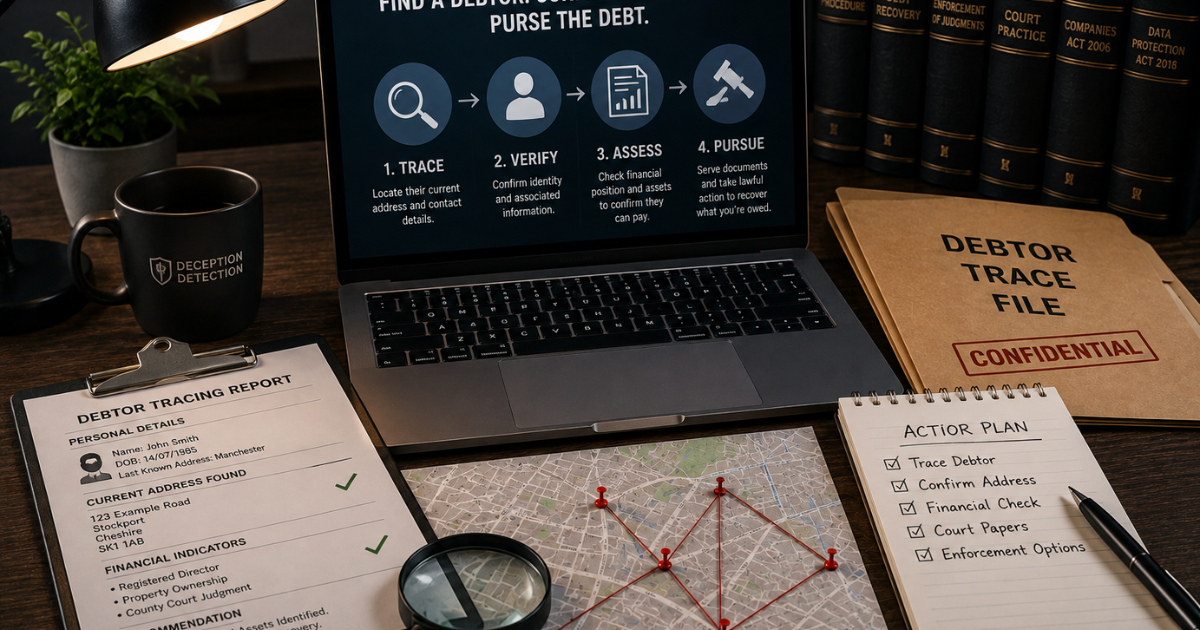
How to Find Someone Who Owes You Money
Locate a debtor, confirm whether they can actually pay, and serve them properly — the right steps, in the right order, all lawful.
Read more →
Surveillance Evidence and the Family Court: What Actually Helps
How lawful surveillance evidence is used in family proceedings — what carries weight, what backfires, and why the method matters as much as the result.
Read more →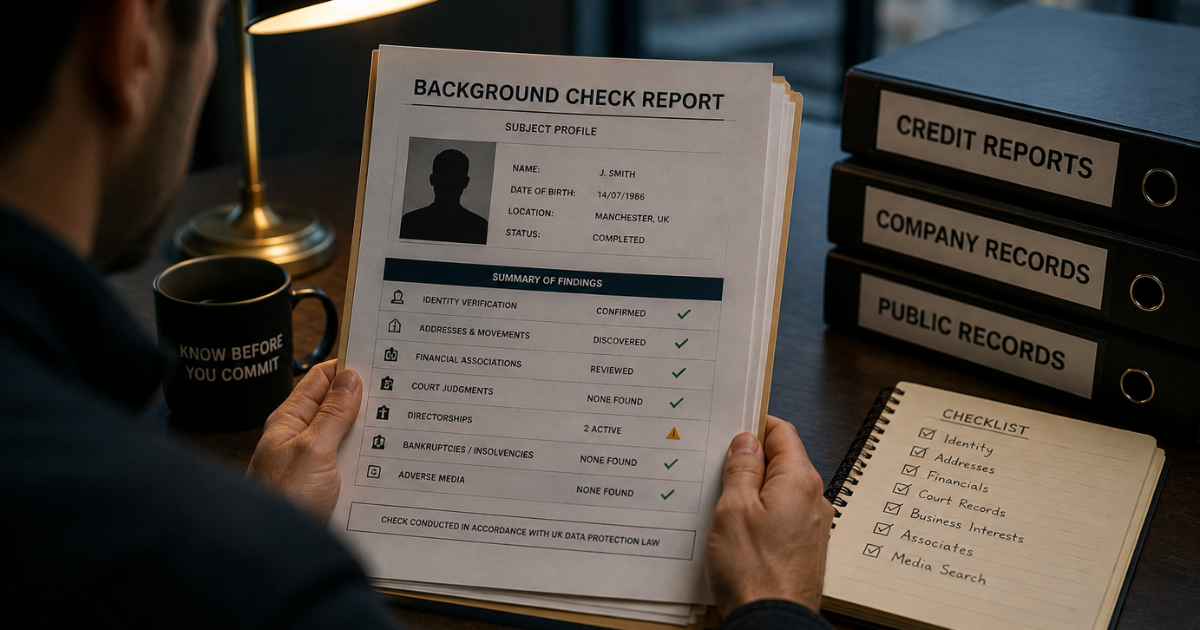
What a Background Check Really Reveals
What a background check can surface — directorships, judgments, identity — what it cannot, and when it is worth doing before you commit.
Read more →Resolve It With Evidence
Email us the situation in confidence. We will tell you honestly whether we can help, the lawful way to approach it, and what it would cost — with strict confidentiality from the first message.
Discuss in Confidence