Find the Person You're Looking For
Professional people tracing across the UK and abroad — missing relatives, lost contacts, debtors, witnesses and beneficiaries. A discreet, lawful trace and a current, verified address you can act on, quoted as a clear fixed fee.
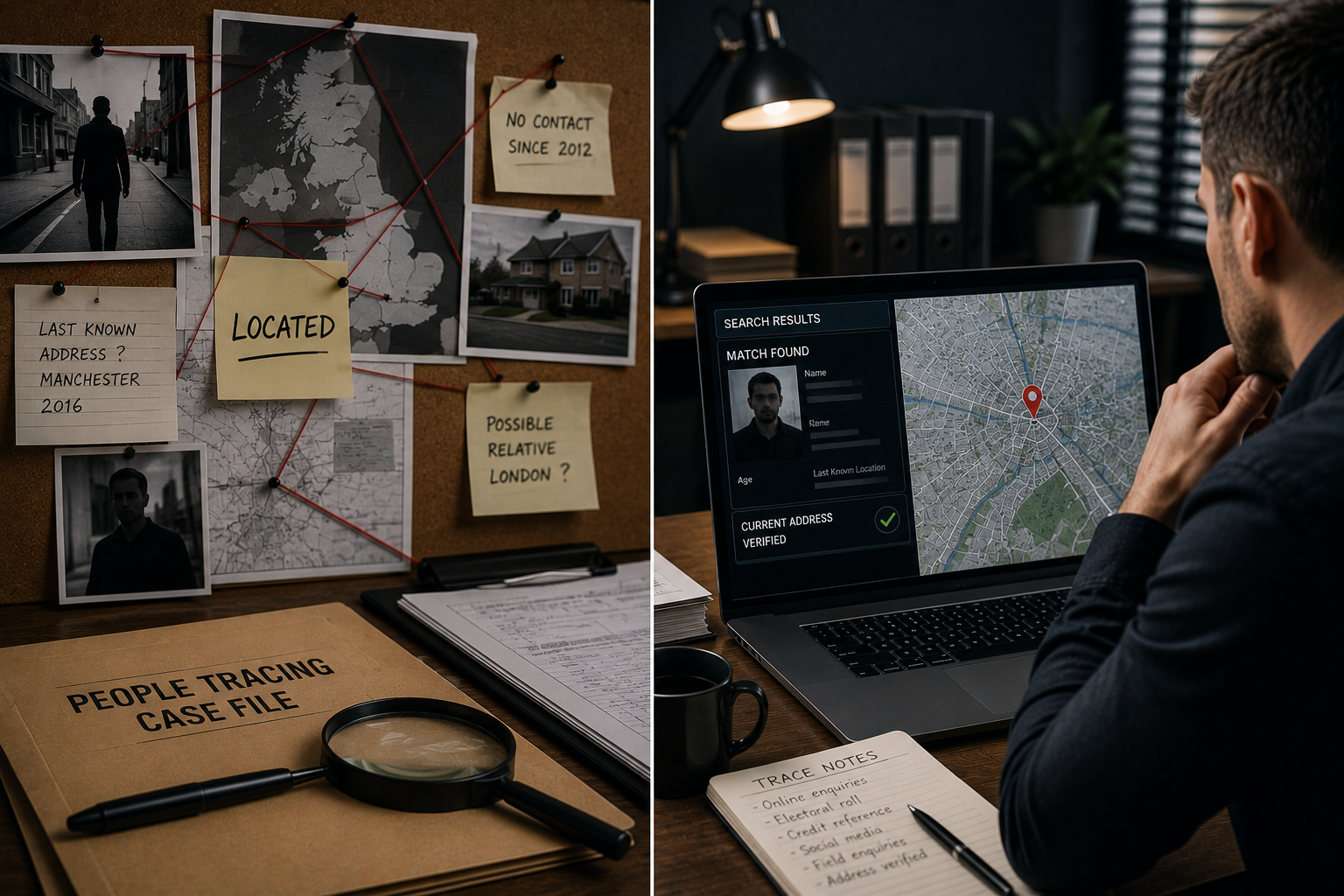
Some people you lose touch with by accident, and some disappear on purpose. Either way, an old address, a common name and a trail that went cold years ago can feel impossible to follow on your own. It rarely is for someone who does this every week.
We trace people across the whole of the UK and internationally, working only from lawful sources and confirming a current address before we report it back to you. Whether you are trying to reconnect with family, recover money you are owed, or find a witness a case depends on, the outcome is the same: a name on a page becomes a real, verified location you can do something about.
Who We Trace
Most traces fall into one of a handful of categories. Whatever yours is, the method is the same: gather what is known, cross-reference lawful records, and confirm before we report.
Missing Family & Relatives
Reconnect with a parent, sibling, child or relative you have lost contact with, sensitively and discreetly.
Lost Contacts & Old Friends
Find a friend, first love, former colleague or someone you simply lost along the way.
Debtors & Absconders
Locate a tenant who left owing rent or a debtor who has gone quiet, with a current address you can act on.
Witnesses & Defendants
Trace witnesses, defendants and people who need serving, supporting solicitors and litigation.
Probate Beneficiaries
Find missing heirs and beneficiaries so an estate can be settled properly and lawfully.
International Traces
Locate people who have moved abroad, with a realistic view of what each country's records allow.
What Makes a Trace Fast — or Slow
The single biggest factor in how quickly and cheaply we can find someone is how much you already know.
A full name on its own is a thin place to start, especially if it is a common one. But a name plus a single anchor changes everything. Any of the following moves a trace forward quickly: a last known address or town, an approximate age or date of birth, a former employer, a vehicle, a partner or family member's name, or an old phone number or email. You do not need all of them — one good anchor is often enough for us to build a picture and confirm it.
What slows a trace down is the opposite: very common names with no distinguishing detail, a person who has deliberately gone off-grid, or someone who has moved between countries. None of these are dead ends, but they take more work, and we are honest about that in the quote rather than discovering it halfway through and asking for more money.
How we actually confirm an address
We do not simply pull a name from a database and send you whatever comes back — that is how people end up knocking on the door of a stranger who moved out three years ago. We cross-reference multiple lawful sources, look for corroboration across them, and confirm that the person genuinely lives at the address before we report it. A verified trace you can rely on is worth far more than a quick guess.
How It Works
A defined task with a clear fixed fee — you know the price before we begin, and you get a verified result.
Tell Us What You Know
Email the person's name and any anchors you have — town, age, old address, workplace, anything.
Fixed-Fee Quote
We assess the case honestly and quote a clear fixed fee and a realistic timescale before starting.
The Trace
We cross-reference lawful sources and confirm the current address, discreetly and without alerting anyone.
Verified Result
You receive a confirmed current address and, where relevant, supporting detail you can act on.
Tracing, Done Lawfully
Tracing is lawful when it is done for a legitimate purpose using legitimate methods, and that is the only way we do it. We work within UK GDPR and the Data Protection Act 2018, use only lawful sources, and are registered with the ICO. We will ask about the reason for a trace, and we will not support one that looks intended to harass or intimidate someone, or to breach a court order or non-molestation order.
That care protects you as much as the person being traced. A lawful trace gives you an address you can rely on and act on cleanly; a dubious one exposes you to real legal risk. Where a trace is the first step toward recovering a debt, we can carry it straight through into asset tracing so you know whether the person is actually worth pursuing before you spend money chasing them. You can see the full range of what we do on our private investigator page.
Why Not Just Search Online Yourself?
It is a fair question — social media, free people-search sites and a few well-chosen searches can sometimes turn something up, and if they do, wonderful. But there are three places the DIY route tends to fall down, and they are the reason people end up calling us after trying it themselves.
The first is common names and stale data. Free tools are full of old addresses, wrong matches and profiles that have not been touched in years. Acting on an unverified hit is how people end up contacting the wrong person entirely, or knocking on a door the person left long ago. The second is people who do not want to be found. Anyone who has deliberately gone quiet will not be sitting on a public profile, and getting past that takes lawful methods and cross-referencing that free sites do not offer. The third is doing it lawfully. It is easy, in the effort to find someone, to stray into methods that breach data protection law or start to look like harassment — which can rebound on you badly. A professional trace stays the right side of that line, confirms the result across multiple sources, and hands you an address you can actually rely on and act on cleanly.
Put simply: if a quick search finds them, you have saved yourself a fee. If it does not, that is exactly what we are for.
Find Them, Then Verify
Once you have found someone, the harder question is often whether to believe what they tell you. As specialist EEG lie-detection providers we can follow a trace with a recognition test, giving you both the location and the verification a standard tracing agent cannot.
Explore Lie Detection TestingWhat to Send Us to Start
You do not need to have everything, but the more of the following you can include in your first email, the faster and cheaper the trace tends to be. Send whatever you have and we will work with it:
- Full name, including any previous names, maiden names or spellings you have seen used.
- Any last known location — a town, a street, a full former address, or even the area you believe they moved to.
- Approximate age or date of birth, which is one of the strongest ways to separate your person from everyone who shares their name.
- A connection — a former employer, a partner or relative's name, a school, a club, or a business they ran.
- Old contact details such as a previous phone number, email address or social media profile, however out of date.
- The reason for the trace, which helps us confirm it is a legitimate purpose and tailor the approach.
If all you have is a name, send that anyway — we will tell you honestly whether it is enough to work with or what single extra detail would make the difference.
Reconnecting With Care
Not every trace is about money or litigation. A great many are personal — a parent trying to find a child they lost contact with years ago, an adopted person searching for a birth relative, someone wanting to make peace before it is too late. These cases deserve particular sensitivity, and finding the address is often the easier half.
When a trace is an emotional reconnection, we can hand you the confirmed location and then talk through how to make first contact thoughtfully. People who have not heard from you in a long time may need a careful, low-pressure approach rather than an unexpected knock at the door, and the person you have found has a right to decide whether they want contact too. We will never push you toward a reckless approach, and we treat the whole process as the delicate thing it is. If your reason for tracing relates to a debt or a dispute instead, the path runs the other way — toward asset tracing and, where useful, the support we give solicitors and litigation.
Difficult and long-cold cases
Some people are genuinely hard to find: a very common name with nothing to distinguish it, decades since the last contact, or someone who has deliberately made themselves difficult to locate. These are not automatic dead ends, but they take more work and we price and plan them honestly. We would rather tell you at the quote stage that a case is a long shot than take your money and disappoint you, and where the odds are poor we say so plainly.
Frequently Asked Questions
The questions we are asked most about tracing someone.
Often, yes. A full name alone is a thin start, but a name plus one anchor — a last known town, an approximate age, a former address, a workplace or a date of birth — is usually enough for us to build and confirm a current address. The more you can tell us, the faster and cheaper the trace.
People tracing is a fixed-fee, defined task rather than open-ended work, typically from around 195 pounds depending on how much identifying information you can provide and how far the person has gone to stay unfound. We quote a clear fixed fee up front before starting.
Many traces are completed within a few working days. Straightforward cases where you have good identifying details can be quicker; cases involving common names, people who have moved abroad, or someone actively avoiding contact take longer. We give you a realistic timescale with your quote.
Yes, when done lawfully. We work within UK GDPR and the Data Protection Act 2018 and use only legitimate sources and methods. We will not support tracing that appears intended to harass, intimidate or breach a court order, and we may ask about the purpose of a trace before accepting it.
No. A trace is discreet — we confirm the person's whereabouts without alerting them and without disclosing who instructed the work. What you do with the address afterwards is your decision, and we can advise on approaching sensitive reconnections carefully.
We are honest about the odds before we take a case, and we scope the fee to the information available. If a trace genuinely cannot be completed we tell you plainly rather than running up open-ended costs. Ask us about our approach for difficult cases when you enquire.
Yes. Debtor tracing is one of our most common jobs — a tenant who left owing rent, a customer who vanished, a defendant who needs serving. We provide a current, verified address you can act on, and we can pair it with asset tracing where you need to know whether pursuing the debt is worthwhile.
Yes. We handle international tracing enquiries as well as UK-wide ones, though overseas traces vary considerably in time and cost depending on the country and the records available there. Tell us where you think the person may be and we will tell you what is realistic.
From the Blog
Practical guides on tracing people, gathering evidence and checking who you are dealing with.
How to Trace a Missing Person in the UK
What you can do yourself, why traces stall, and how a professional finds and verifies a current address for a missing relative or beneficiary.
Read more →
How to Find Someone Who Owes You Money
Locate a debtor, confirm whether they can actually pay, and serve them properly — the right steps, in the right order, all lawful.
Read more →
Surveillance Evidence and the Family Court: What Actually Helps
How lawful surveillance evidence is used in family proceedings — what carries weight, what backfires, and why the method matters as much as the result.
Read more →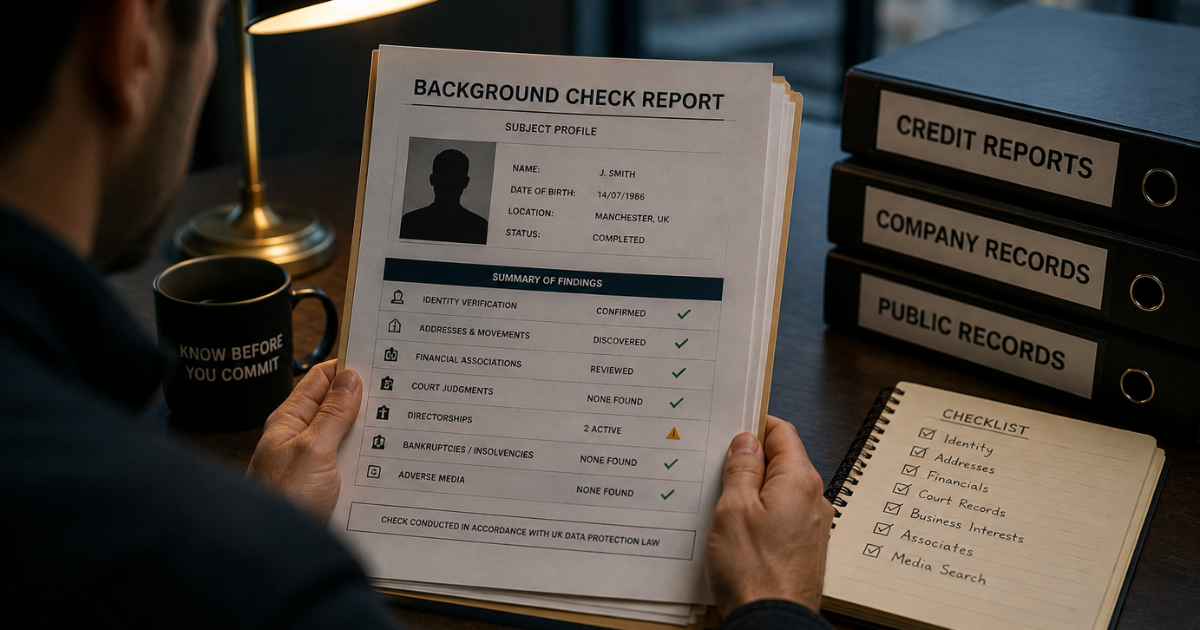
What a Background Check Really Reveals
What a background check can surface — directorships, judgments, identity — what it cannot, and when it is worth doing before you commit.
Read more →Let's Find Them
Email us the name and whatever else you know. We will tell you honestly how findable the person is, what it would cost, and how long it should take — before you commit to anything.
Start a Trace