Surveillance Evidence and the Family Court: What Actually Helps
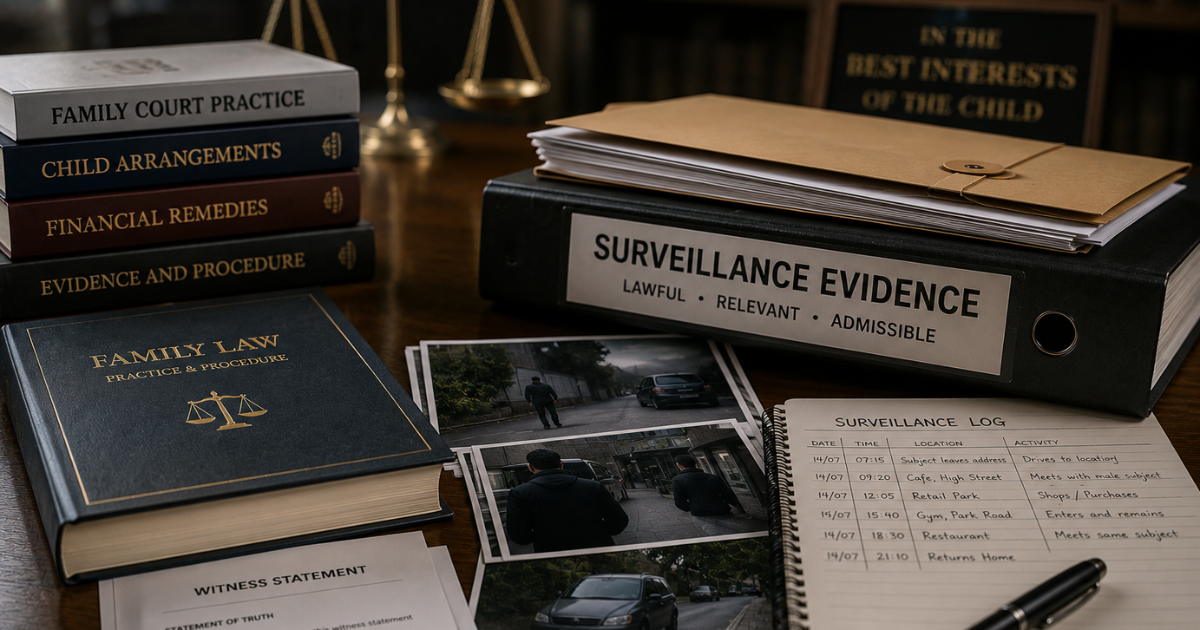
Family disputes turn on facts that are often contested — who a child is really being exposed to, whether a cohabitation is being hidden to protect maintenance, whether an account of someone's life is true. Where those facts matter, lawful investigation evidence can carry real weight. But how it is gathered decides whether it helps you or hurts you.
Where investigation evidence is used
- Child arrangements. Establishing who a child spends time with, or the environment they are in during contact, where there are genuine welfare concerns.
- Maintenance and finances. Evidence of undisclosed cohabitation, hidden work or concealed assets that bear on a financial settlement.
- Disputed accounts. Situations where one party's version of their circumstances does not match reality.
What actually carries weight
Courts value evidence that is objective, lawful and clearly documented. Time and date-stamped photographic and video material from professional surveillance, gathered in public where there is no reasonable expectation of privacy, is far more persuasive than assertion. A clear, factual written report — who, what, where, when — prepared to a court-standard format, is what solicitors can actually put before a judge.
What does not help — and can backfire
Evidence obtained unlawfully is worse than no evidence. Recordings made by trespassing, hacking a phone or account, or tracking a vehicle you have no authority over can be ruled inadmissible and can expose you to criminal liability — handing the other side a powerful counter-narrative about your conduct. Judges also see through material that is selectively edited or presented to mislead. In family proceedings, where the court weighs each party's behaviour, self-help of this kind frequently damages the person who relied on it.
Why the method matters as much as the result
This is the heart of it. The same fact — say, a hidden cohabitation — can be a decisive piece of evidence or a liability, depending entirely on how it was obtained. Professional investigators work within data-protection, privacy and harassment law precisely so the findings survive scrutiny and support your case rather than undermining it. Much of this work is instructed by or alongside a solicitor, and a good investigator is comfortable coordinating with your legal team.
Working alongside your solicitor
The strongest use of investigation evidence is coordinated with your legal team rather than sprung on them. A solicitor can advise what is proportionate and relevant to the issues the court is actually deciding, and an investigator can then gather exactly that — no more, no less — in a form that slots straight into the proceedings. Evidence produced this way is targeted and admissible, which is far more useful than a mass of material gathered on a hunch. If you do not yet have a solicitor, a good investigator can still make sure what is gathered is lawful and usable.
If you think evidence could matter in your proceedings, the right first step is a confidential conversation about what is lawful and what would genuinely help — before anything is done that cannot be undone.
Building a case?
Discreet, lawful evidence to a court-standard, prepared to support you and your solicitor.
Discuss Your Case