Pre-Employment Lie Detector Test — UK Wide
Pre-employment lie detector testing for the UK employers, hiring managers and private vetting. Verify candidate claims about previous conduct, gaps in CV, declared convictions, or anything else that matters to your hiring decision. From £499 per candidate. Volume rates from the fifth test.
£499
Per Candidate
95%
Accuracy
-15%
From 5th Test
Both
Get Report
Pre-Employment Lie Detector Testing in the UK — Honest Service Description
A pre-employment lie detector test in the UK answers a question that DBS checks, reference calls and standard background screening cannot: does the candidate's own account of themselves stand up. The test is structured around specific verifiable claims the candidate has made to the employer — about past conduct, about reasons for leaving previous roles, about disclosed convictions, about gaps in employment, about substance use, about anything the hiring manager and the candidate have agreed it is appropriate to test. The candidate's voluntary informed consent is mandatory. We will not test anyone who has not actively chosen to take the test. For employers in the UK, the value is supplementary — a piece of objective input that sits alongside DBS, references, interviews and skills assessment, not a replacement for any of them. Pricing starts at £499 per candidate. Volume discount of 15 percent applies from the fifth test in a calendar year. Retainer arrangements are available for firms hiring regularly into high-trust roles. We are upfront that lie detector reports are not admissible in UK courts and should not be used as the sole grounds for rejecting a candidate. We are very clear on that in every case briefing.
Standard pre-employment checks in the UK answer the questions a paper trail can answer. DBS confirms recorded convictions. References confirm what previous employers will put in writing. The CV confirms what the candidate wants you to know. None of these directly verifies whether the candidate is being straight with you on specific contested facts. Our test fills exactly that gap — for the questions you have decided are important enough to verify, with the candidate's voluntary consent.
How Pre-Employment Testing Helps Hiring Decisions
There are six concrete ways our the UK employer and private vetting clients use the test result. The test is supplementary to your other checks — not a replacement, not a magic wand.
Verify Specific CV Claims
Reasons for leaving previous roles, gaps in employment, disclosed convictions, contested past conduct — anything the candidate has stated that you want directly verified rather than inferred from references.
Tighten High-Trust Hires
Roles handling cash, sensitive data, vulnerable people, or representing the firm externally. The test adds one defensible data point to the senior hiring decision.
Domestic Staff Vetting
Nanny, live-in carer, housekeeper, driver. Test specific claims about previous arrangements with full candidate consent. The report goes to both you and the candidate.
Tenant Vetting
Private landlords letting a high-value property can verify specific claims about previous tenancies, employment status or disclosed circumstances before signing a contract.
Business Partner Due Diligence
Pre-investment, pre-partnership, pre-co-founder. Verify specific contested claims about past business conduct, undisclosed conflicts, or motivation — with consent on both sides.
Standardise the Process
Retainer firms use the test as one consistent input across all candidates for a category of role. Not the determining factor — just one more standardised input alongside DBS and references.
Important: the test requires the candidate's voluntary informed consent. We will not test anyone who has not actively chosen to take the test. We discourage using the report as sole grounds for rejection — it is supplementary to other checks, not a replacement.
No Wires. No Straps. Just a Headband.
A traditional polygraph straps sensors to your chest, fingers, and arm — measuring sweat, breathing, and blood pressure while you sit in stress. Our P300 EEG test uses a single lightweight headband that reads brain activity directly. No discomfort, no intimidation, and it's over in under 90 minutes.
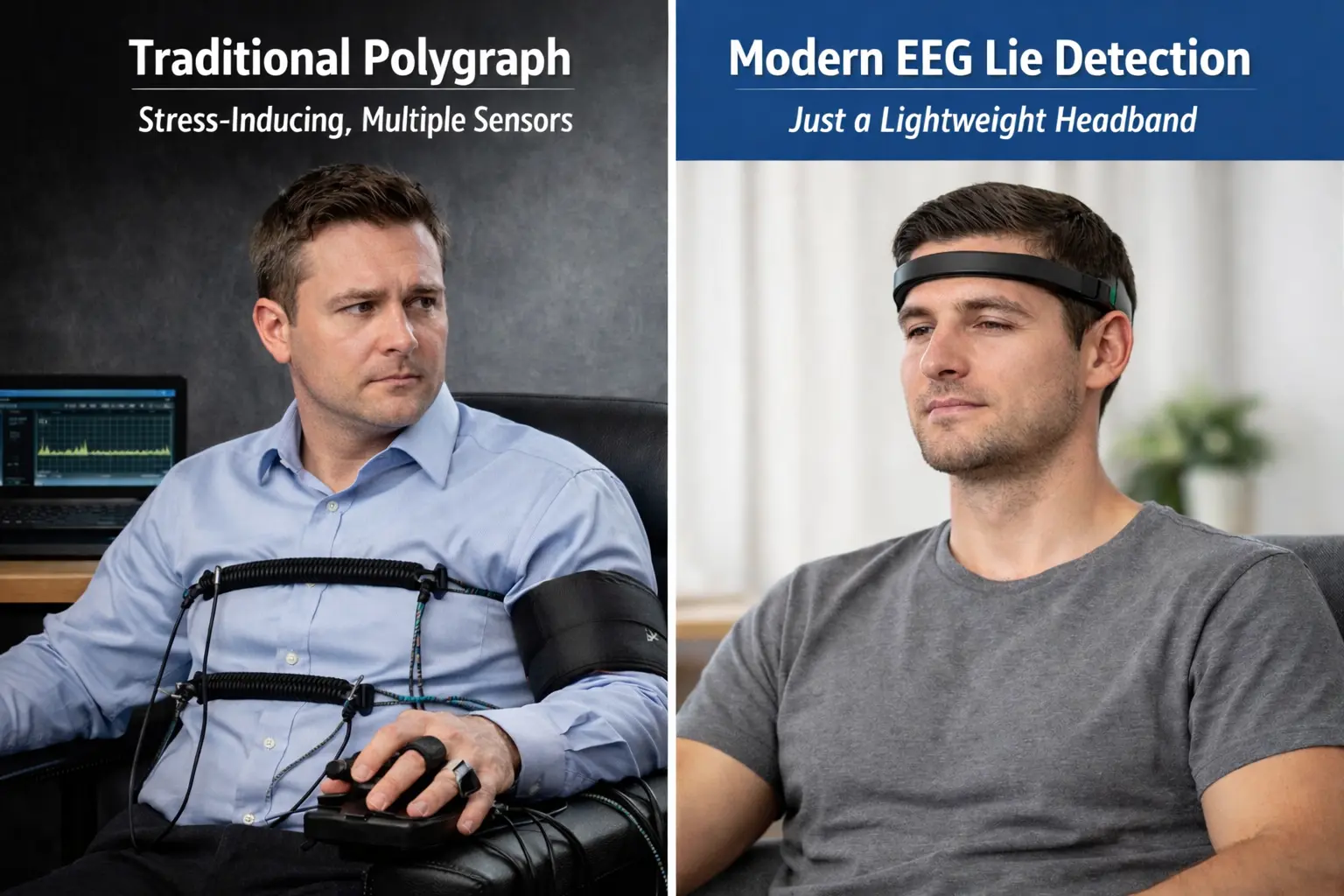
Right: P300 EEG – minimal, non-invasive headband.
Common Pre-Employment Vetting Scenarios
The four most common contexts where the UK hirers instruct the test. Each has slightly different question design and report format.
High-Trust Corporate Hires
Finance, compliance, IT security, executive leadership. Roles where one bad hire can do disproportionate damage. Test specific claims about past conduct or contested CV items.
Domestic Staff
Nanny, live-in carer, housekeeper, driver, gardener. People with access to your home and family. DBS gives one signal; the lie detector test adds another. Voluntary consent throughout.
Private Tenant
Letting a high-value property to an applicant. Verify specific claims about employment, previous tenancies or disclosed circumstances before signing the tenancy agreement.
Investor / Partner Due Diligence
Pre-investment vetting of a founder, pre-partnership check on a prospective business partner. The contested specifics of past business conduct that standard DD cannot reach.
How the Booking Works
Five stages from submitting the booking form to the report landing in your inbox. Same process whether your test is next week or this afternoon.
Fill Out the Booking Form
Submit your details online. Takes under two minutes. No payment until the booking is confirmed by phone.
Assessor Calls You Back
Within minutes an assessor calls to finalise the questions, confirm your the UK location and discuss what the test can do for your specific situation.
Examiner Dispatched
The examiner travels to your private venue in the UK — your home, a hotel room, anywhere private.
Test On Site
The eight-channel EEG test runs for around twenty minutes. The brainwave response cannot be faked.
Report Within One Hour
The written report is dispatched encrypted to your email within one hour of the test ending. Comprehensive and fully detailed.
Same-day available: Book before 1pm for same-day testing in the UK. Evening tests until 9pm.
What the Test Can and Cannot Do — Honest Version
We will not oversell this. Knowing the limits up front means you book with realistic expectations and use the report effectively.
What the test CAN do
- Verify specific claims the candidate has made, with 90 to 95 percent accuracy
- Add one defensible data point to your hiring decision alongside DBS, references, interviews
- Help standardise the input across all candidates for a category of role
- Surface inconsistencies that warrant further investigation before offer
- Test things you cannot verify via standard background checks (motivation, past conduct claims, undisclosed circumstances)
- Be used with voluntary consent for both employer-paid hiring and private vetting
- Provide a signed expert report to both the hirer and the candidate
What the test CANNOT do
- Be the sole basis for rejecting a candidate — that creates equality and GDPR risk you do not want
- Replace DBS, references, or other formal background checks
- Defend an unfair-dismissal or discrimination claim — lie detector reports are not court evidence
- Be used without the candidate's voluntary informed consent
- Test for protected characteristics or anything not directly relevant to the role
- Guarantee a candidate's future conduct — it tests past contested facts, not behaviour going forward
Why we say this up front: too many lie detector services overpromise. We would rather you book with realistic expectations and find the report genuinely useful than book with inflated hopes and feel let down. The test is powerful private evidence — it is not court evidence, and we will never pretend otherwise.
Where We Can Conduct the Test in the UK
The test does not require a clinic. The equipment is portable and the test runs in any private quiet space for around ninety minutes total including setup.
Your Home
Most common venue. Any quiet room with a chair and table works. The kit is professional but unobtrusive.
Hotel Meeting Room
For maximum discretion we regularly use Premier Inn, Holiday Inn, ibis and similar across the UK.
Office or Serviced Room
Your office, a serviced meeting room, or any private business space works for the test.
Anywhere Private in the UK
Serviced apartment, conference centre, private rental. Tell us your situation and we help find a venue.
Pricing — Transparent and Inclusive
No hidden fees. No travel surcharges within mainland UK. The price you see is the total cost of the test, the examiner attendance and the written report.
One-off pre-employment test
- Full eight-channel test
- Comprehensive signed report
- Report goes to hirer AND candidate
- Same-day option £599
- UK mainland examiner attendance
Priority scheduling, account manager
- Everything in Per Candidate, plus:
- Rate locked for 12 months
- Priority scheduling within 48 hours
- Dedicated named account manager
- Monthly consolidated invoicing
- Direct line for hiring managers
Volume discount on subsequent tests
- 15% off from the 5th test in a calendar year
- Applies to all subsequent tests that year
- Multi-candidate same session: +£399 each
- 30-day billing terms
- No commitment required to qualify
Why Our Test Is More Accurate Than a Polygraph
We use brainwave-based detection rather than the older polygraph. The difference matters when the candidate is anxious — which most candidates are during pre-employment testing.
Brainwave Response (Our Test)
Clean spike at 300ms — recognition confirmed. Involuntary. Cannot be faked.
One clear, measurable response. Cannot be faked. 90–95 percent accurate.
Traditional Polygraph
Chaotic stress signals — sweat, heart rate, breathing. Anxiety looks identical to deception.
Around 60 percent accurate. Anxiety can make innocent people fail.
Why This Matters for Pre-Employment Testing
Candidates taking a pre-employment test are by definition under stress — the job depends on it. A polygraph measures stress. That is why innocent candidates can fail polygraphs. Our brainwave test measures recognition responses, not stress, so a nervous truthful candidate produces the same result as a calm truthful candidate.
Accuracy figures from peer-reviewed research including Farwell & Donchin 1991, P300 neuroscience overview, and subsequent independent replication studies.
Real Pre-Employment Vetting Outcomes
Anonymised real outcomes from the UK hirers and private vetting clients who used the test as one input into a hiring decision. All conducted with candidate consent. The report does not determine the hire — it just makes the decision better-informed. View the full case studies library →
CV Inconsistency Surfaced Before Live-In Carer Placement
A care agency was hiring a live-in carer for an elderly client. The candidate's references were good but had a gap they explained as personal travel. With the candidate's consent, the agency instructed a pre-employment test focused on the gap and on disclosed conduct in previous roles. The test surfaced inconsistencies on the gap explanation that the agency followed up with a more detailed reference. The candidate withdrew rather than continue. The agency placed an alternative candidate. The test cost £499 — placing the wrong carer with a vulnerable client would have cost far more.
Read full case →

Senior Candidate Cleared, Hire Proceeded with Confidence
A mid-sized financial services firm was hiring a CFO. The preferred candidate had left their previous role under unclear circumstances and references were vague. With the candidate's consent, a pre-employment test focused on the specific contested questions about the previous role. The test cleared the candidate. The references' caution turned out to be a personality clash rather than a conduct issue. The firm proceeded with the hire. Two years on the CFO is still in role and the firm has scaled significantly.
Read full case →Peace of Mind Before Live-In Childcare Arrangement
A family hiring a live-in nanny for two young children completed standard DBS and reference checks. The successful candidate volunteered to take a pre-employment lie detector test to give the parents additional confidence. The test confirmed her account on every contested question — previous employers, gap in employment, declared circumstances. The family hired her and she has been with them for two years. The candidate later said volunteering for the test had been the right call — she would do it again for any family-side role.
Read full case →

Owner-Operator Avoided a Catastrophic First Hire
A sole-trader expanding to her first employee was hiring a deputy who would have full access to client accounts and till. The successful candidate was charming, references were positive, but something felt off in the interview. The owner instructed a pre-employment test with the candidate's consent, focused on prior workplace conduct. The test surfaced inconsistencies that prompted the owner to call previous employers more carefully. A pattern of cash-handling concerns emerged that earlier references had glossed over. The hire did not proceed. Six months on the business is thriving with a different deputy.
Read full case →Pre-Investment Test Cleared Founder, Deal Closed
An angel investor was finalising a six-figure investment into an early-stage company. Standard due diligence had thrown up an unresolved question about the founder's reasons for leaving a previous venture. The founder voluntarily took a pre-employment-style test focused specifically on that question. The test cleared him on the contested point. The investor closed the deal at the agreed valuation. The founder reported afterwards that having taken the test made him feel the investor trusted him — which set up the working relationship well.
Read full case →

High-Value Property Let with Confidence
A private landlord was letting a £4,500-per-month executive flat. The applicant's employment claim could not be fully verified through standard checks because of a recent role change. With the tenant's consent, the landlord instructed a pre-employment-style test focused on the disputed employment situation. The test cleared the tenant. The tenancy went ahead. Eighteen months on the tenant has been faultless. The cost of the test was less than half of one month's rent and far less than the cost of an unrecoverable arrears situation.
Read full case →Reviews from Hirers and Vetting Clients
Verified reviews from the UK employers, hiring managers, families and private clients who used the test as part of a hiring decision. Aggregate rating 4.9 of 5 from 499 reviews.
Care agency hiring a live-in carer. The CV had a gap we wanted to verify. The test surfaced inconsistencies that we followed up with deeper reference checks. Candidate withdrew. Placed someone else. The test paid for itself many times over.
Hiring a CFO. References were vague about why he left the previous role. Test cleared him on the contested questions. Two years on he is still in role and we have scaled significantly. Glad we did the test rather than letting vague references sink the offer.
Family hiring a live-in nanny. The candidate offered to take the test, which actually told us something positive about her. She passed everything. She has been with our children for two years now.
Sole trader hiring my first employee. Something felt off in interview. Test surfaced what felt off. I called previous employers harder and a cash-handling pattern emerged. Did not hire. Saved me from a disaster.
Pre-investment due diligence on a founder. Vague reasons for leaving previous venture. Founder voluntarily took the test and was cleared on the contested point. Closed the deal. Set up the relationship well.
Letting a high-value property. Tenant had a recent job change that we could not verify cleanly. Test cleared the contested point with her consent. Tenancy went ahead, eighteen months on she is faultless.
Retainer arrangement, six hires per year into compliance-sensitive roles. Standard process now: DBS, references, interview, test. Test does not determine hires but flags candidates who need more reference work. Worth every penny of the retainer.
Honest about the limits. They told me explicitly the test should not be the sole reason to reject a candidate and we should use it as supplementary. That actually built more trust than if they had oversold it.
Articles on Pre-Employment Vetting
Deeper context on pre-employment vetting and how lie detector testing fits into a structured hiring process.
What Pre-Employment Lie Detector Testing Can and Cannot Defend
Why using the test as sole grounds for rejection creates equality and GDPR risk for the hirer — and how to use the report properly as supplementary input.
Read article →Standardising the Hire — Pre-Employment Testing in Hiring Workflows
How firms that hire repeatedly into the same kinds of roles use the test as one consistent input alongside DBS and references, baseline-comparable across candidates.
Read article →Getting Pre-Employment Test Consent Right
What voluntary informed consent actually means in pre-employment testing — and how to frame the request to candidates without it feeling coercive.
Read article →Pre-Employment Testing for Live-In Domestic Staff
Nannies, carers, housekeepers, drivers. Why families increasingly use the test alongside DBS for the highest-trust private hires.
Read article →Lie Detector Testing in Senior Leadership Hiring
How CFO, COO and sales director searches use the test for the contested specifics that references cannot reach. Includes recent UK case examples.
Read article →Private Landlord Pre-Tenancy Vetting
When tenant referencing comes back inconclusive on a high-value let, the test gives the landlord one more verified data point with the tenant's consent.
Read article →Pre-Investment Founder Due Diligence
Angel investors, VC partners and acquirers use the test on specific contested points that standard due diligence cannot directly verify.
Read article →Why a Polygraph Is the Wrong Tool for Pre-Employment Testing
Candidates are nervous by definition during pre-employment testing. Polygraphs measure nerves. Our brainwave test does not. Why this matters for hiring accuracy.
Read article →Further Reading
On this site
External authoritative sources
Pre-Employment Testing FAQ — the UK
The questions hirers most often raise at the case briefing. Tap each one to expand.
Is pre-employment lie detector testing legal in the UK?
Does the candidate have to consent to the test?
Can the pre-employment test result be admitted in an employment tribunal if the candidate sues?
Can we use the test instead of DBS or reference checks?
What if the candidate refuses to take the test?
Will the test reveal personal information the candidate hasn't disclosed?
How does volume pricing work for firms hiring regularly?
What roles is pre-employment testing appropriate for?
How quickly can we get a candidate tested in the UK?
Does the candidate get a copy of the report?
Can private individuals use the test for domestic staff vetting?
Can the candidate be too anxious to take the test reliably?
Instruct your first pre-employment test in the UK this week. Send a brief from your hiring manager — case officer confirms availability and pricing within the hour.
Submit the booking form and an assessor calls within minutes. The first conversation is free and confidential — we will give you an honest assessment of whether the test can help your specific situation before you commit to anything.
Last updated: 1 September 2026