Lie Detector Test for False Accusations — UK Wide
Falsely accused in the UK? Our lie detector test gives you an independent written report on your account — for yourself, your family, your employer, your accuser. £499. Same-day appointments available.
£499
Standard Test
95%
Test Accuracy
1hr
Report Time
100%
Your Report
Why People Come To Us
Stop wondering, Doubt ends here.
The clarity you came for. Your report, the same day.
Doubt ends here.
The question you've been carrying for months — sometimes years — ends in a single 90-minute session. No more wondering.
The clarity you came for.
A clear written result on the specific questions you were tested on, with the examiner there to explain what it means.
Your report, the same day.
Your written report is in your hand the same hour the headband comes off. Same-day appointments available across the UK.
Falsely Accused in the UK? Here Is What the Test Actually Does
A false accusation does not just damage your reputation — it damages your ability to trust your own memory of what happened. After enough days of being told you did something you know you did not do, even innocent people start to wonder. Clients reach out to us in exactly this state. The accusation may be at work, in a family situation, from a partner, or in a wider community context. The first thing our test gives you is back your certainty. Our brainwave-based lie detector measures involuntary recognition responses in the brain — responses that are far harder to control than the stress signals a polygraph reads, though no method is immune to deliberate countermeasures. Laboratory research on this recognition method reports accuracy of roughly 80 to 95 percent; those are published research figures, not results from our own testing. The written report is yours. You decide what you do with it: share it with the person who accused you, with HR, with your family, with anyone whose belief matters. Or keep it private, purely for your own certainty. £499, whether you book days ahead or same-day. The report is delivered within one hour of the test ending. We are upfront that lie detector reports are not admitted in UK courts — but they are useful private material for everything that happens outside of court.
The damage of being falsely accused is not just the accusation itself — it is the prolonged period of being doubted. Clients describe it as a kind of slow erosion where, after enough days of telling people you did not do something, you start to question your own memory. The test stops that. Whatever else happens with the formal process, you have an independent written report on your own account. Even if you never share the report, having it in hand changes how you carry the accusation.
How the Test Helps the Falsely Accused
There are six concrete ways our clients use the test result when they have been falsely accused. You decide which apply to your situation.
Reclaim Your Own Certainty
The first damage of a false accusation is doubt creeping into your own head. The test gives you an independent check on your own account of what happened.
Support Your HR Case
Disciplinary panels are not bound by court rules of evidence. They can consider a lie detector report, and many do. Hand it to HR, your union rep, or the panel itself.
Rebuild Trust at Home
When a partner or family member has doubted you, the test gives them something objective to accept. Some clients tell us that was the turning point.
Shift the Negotiation
If you are in a dispute — separation, partnership breakdown, business conflict — disclosing the report often shifts the dynamic without further escalation.
Defend Your Reputation
Share selectively with the people whose opinion of you matters. The report gives them a reason to trust you that does not depend on simply believing your word.
Make Your Own Decision
Fight or settle, defend or withdraw, escalate or move on. The test gives you objective input into the decisions a false accusation forces on you.
Important: lie detector reports are not admitted as evidence in UK courts. Every use above is outside court — where you have full control over who sees your report and how it is used.
Common False Accusation Scenarios
The four most common contexts where clients book the test. Your situation does not need to match exactly — these are illustrative.
Workplace Accusation
Theft, misconduct, harassment, breach of policy. You are suspended pending an internal investigation. The test gives HR something objective to weigh.
Relationship Accusation
A partner accusing you of something you did not do — dishonesty, money, broken promises. The test gives the relationship the basis to rebuild on.
Family Accusation
Allegations made during separation, by an ex-partner, by an adult child, by a parent. Often deeply unfair, often unresolvable through conversation alone.
Reputation Accusation
A public accusation — social media, WhatsApp group, community forum. The accusation has taken over the narrative. You need something objective to push back with.
How the Booking Works
Five stages from submitting the booking form to the report landing in your inbox. Same process whether your test is next week or this afternoon.
Fill Out the Booking Form
Submit your details online. Takes under two minutes. No payment until the booking is confirmed by phone.
Assessor Calls You Back
Within minutes an assessor calls to finalise the questions, confirm your location and discuss what the test can do for your specific situation.
Examiner Dispatched
The examiner travels to your private venue in the UK — your home, a hotel room, anywhere private.
Test On Site
The EEG recording takes around twenty minutes, within a 60 to 90 minute appointment including setup and briefing. A lightweight 4-channel EEG headband is all you wear.
Report Within One Hour
The written report is dispatched encrypted to your email within one hour of the test ending. Comprehensive and fully detailed.
Same-day available: Book before 1pm for same-day testing in the UK. Evening tests until 9pm.
What the Test Can and Cannot Do — Honest Version
We will not oversell this. Knowing the limits up front means you book with realistic expectations and use the report effectively.
What the test CAN do
- Give you an independent written report on whether you recognise the specific details in question
- Support your case in internal HR / disciplinary investigations
- Give a partner, family member or friend something objective to accept
- Help shift the dynamic in private disputes and negotiations
- Give you certainty for your own decision-making
- Help you defend your reputation with selected people
- Provide a signed expert report you can keep, share, or use as you choose
What the test CANNOT do
- Be used as evidence in a UK court — lie detector reports are not court-admissible and never have been
- Force your accuser to take a test themselves
- Stop a formal process (criminal, family court, regulatory) that has already started
- Prove that your accuser is lying — only that your account is consistent with brain recognition responses
- Guarantee that everyone who sees the report will accept it
- Substitute for legal advice in serious cases — speak to a solicitor for that
Why we say this up front: too many lie detector services overpromise. We would rather you book with realistic expectations and find the report genuinely useful than book with inflated hopes and feel let down. The test is powerful private evidence — it is not court evidence, and we will never pretend otherwise.
Where We Can Conduct the Test in the UK
The test does not require a clinic. The equipment is portable and the test runs in any private quiet space for around ninety minutes total including setup.
Your Home
Most common venue. Any quiet room with a chair and table works. The kit is professional but unobtrusive.
Hotel Meeting Room
For maximum discretion we regularly use Premier Inn, Holiday Inn, ibis and similar across the UK.
Office or Serviced Room
Your office, a serviced meeting room, or any private business space works for the test.
Anywhere Private in the UK
Serviced apartment, conference centre, private rental. Tell us your situation and we help find a venue.
Pricing — Transparent and Inclusive
No hidden fees. No travel surcharges within mainland UK. The price you see is the total cost of the test, the examiner attendance and the written report.
24 to 96 hours lead time
- Full 4-channel EEG test
- Comprehensive written report
- Examiner attendance anywhere UK mainland
- Report within 1 hour of test
You and your accuser both tested
- If your accuser agrees to be tested too
- Same session, one examiner visit
- Separate written report for each person
- Rare but powerful when both sides agree
How Our Test Differs From a Polygraph
We use brainwave-based recognition testing rather than a polygraph. The two methods measure different things, which matters when you are under stress.
Brainwave Response (Our Test)
A recognition response around 300ms after a detail the brain knows. Involuntary and fast.
Laboratory research reports roughly 80–95% accuracy. Not results from our own testing.
Traditional Polygraph
Stress signals — sweat, heart rate, breathing. Measures arousal rather than recognition.
Research puts single-issue accuracy around 87–89% (APA, 2011). Nerves are a known source of error.
Why This Matters for the Falsely Accused
If you are falsely accused, you are by definition under stress. A polygraph measures stress responses, so nerves are a recognised source of error. Our test measures recognition of specific details rather than stress, which is why it is less dependent on how anxious you feel on the day.
Published research on the recognition method we use (the P300 concealed information test) reports accuracy of roughly 80 to 95 percent in laboratory studies, with more limited field validation. These are research figures, not results from our own testing. Research on single-issue polygraph testing reports accuracy around 87 to 89 percent (American Polygraph Association, 2011); the US National Academy of Sciences (2003) found polygraph accuracy above chance but well below perfection. No lie detection method is immune to deliberate countermeasures, including P300-based tests (Rosenfeld et al., 2004).
Sources: Farwell & Donchin 1991, P300 neuroscience overview, American Polygraph Association (2011) meta-analytic survey, National Research Council, The Polygraph and Lie Detection (2003), Rosenfeld et al. (2004) on countermeasures to P300-based tests.
Real Cases Where Someone Stood Accused
Anonymised real cases from our library where someone stood accused. Some were cleared and some were not: the test answers the question either way. None of these were court cases. View the full case studies library →
Self-Referred: Closure on a False Workplace Accusation
A workplace conflict-of-interest accusation was closed as "insufficient evidence" rather than as innocent. Eighteen months later, David self-referred for a P300 EEG test. All three probe sets came back clear, giving him a written result he could own.
Read full case →
When It Came Back Clear: A Falsely Accused Partner
Tom's partner asked him to show he was telling the truth, and he agreed straight away. All four probe sets came back clear. The case is written from Tom's side: what the experience was like and what the result gave him.
Read full case →Three Staff: Two Cleared, One Deception-Indicated
£23,000 of stock went missing from a warehouse and three staff were under suspicion. All three were tested in one day. Two were cleared and given written reports; one result was deception-indicated.
Read full case →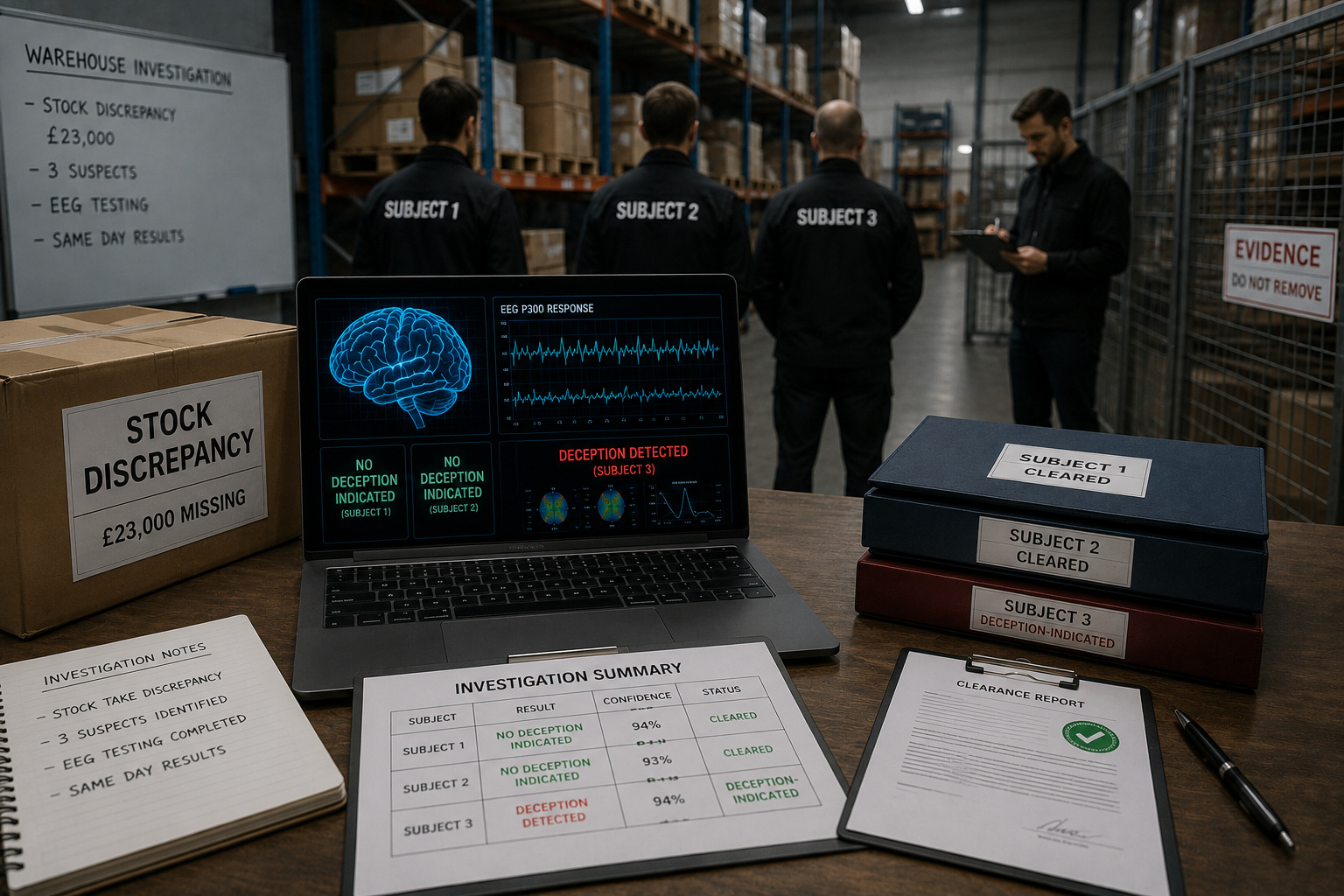
Warehouse: Breaking a Nine-Month Deadlock
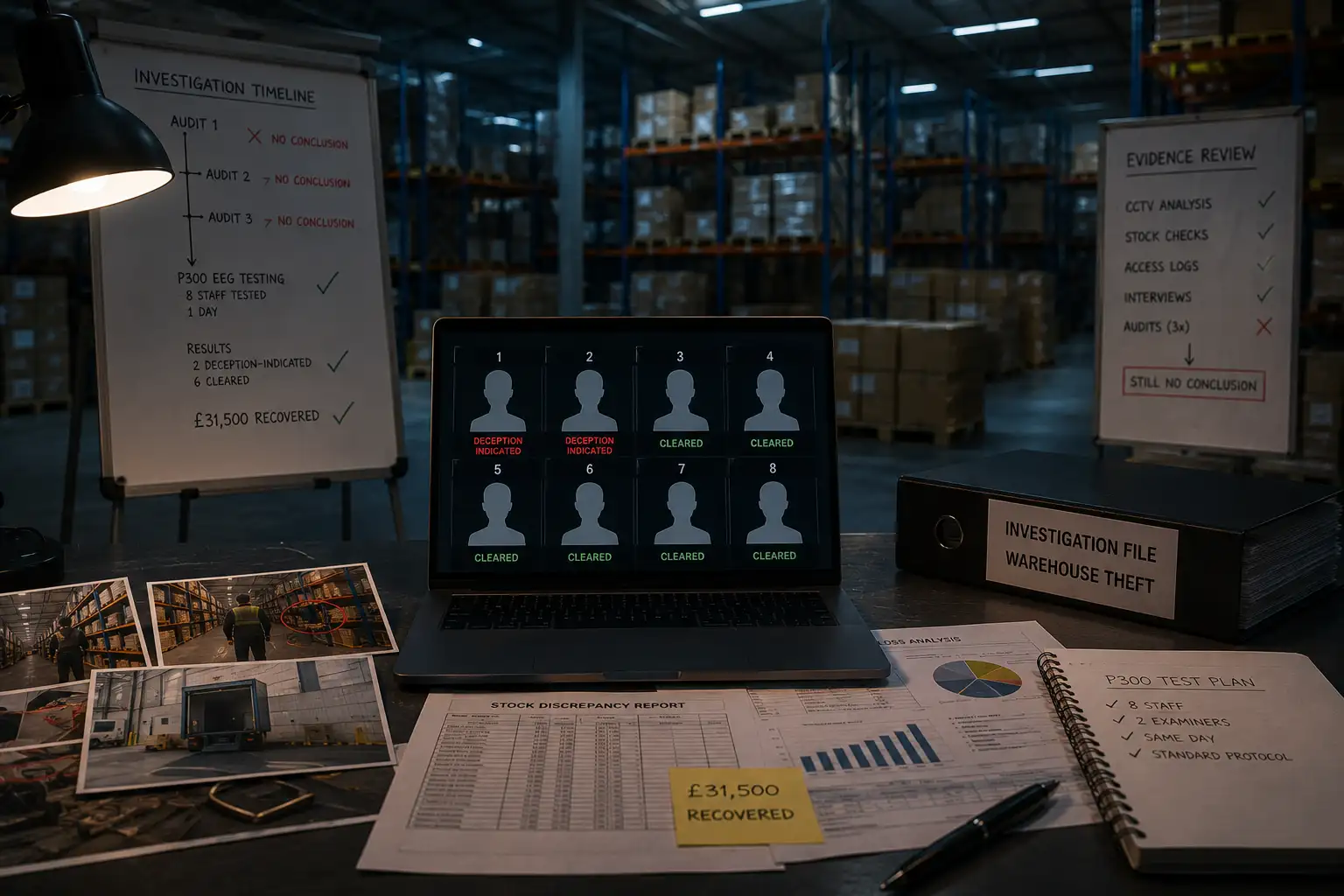
After three failed audits, eight staff were tested by two examiners in a single day. Six were cleared with written reports; two results were deception-indicated, and £31,500 was recovered.
Read full case →Family Business: Three Siblings Tested in One Day
£38,000 went missing from a family building company and three siblings were blaming each other. All three were tested in one day. Two were cleared; one result was deception-indicated. The case study includes the live P300 waveform data.
Read full case →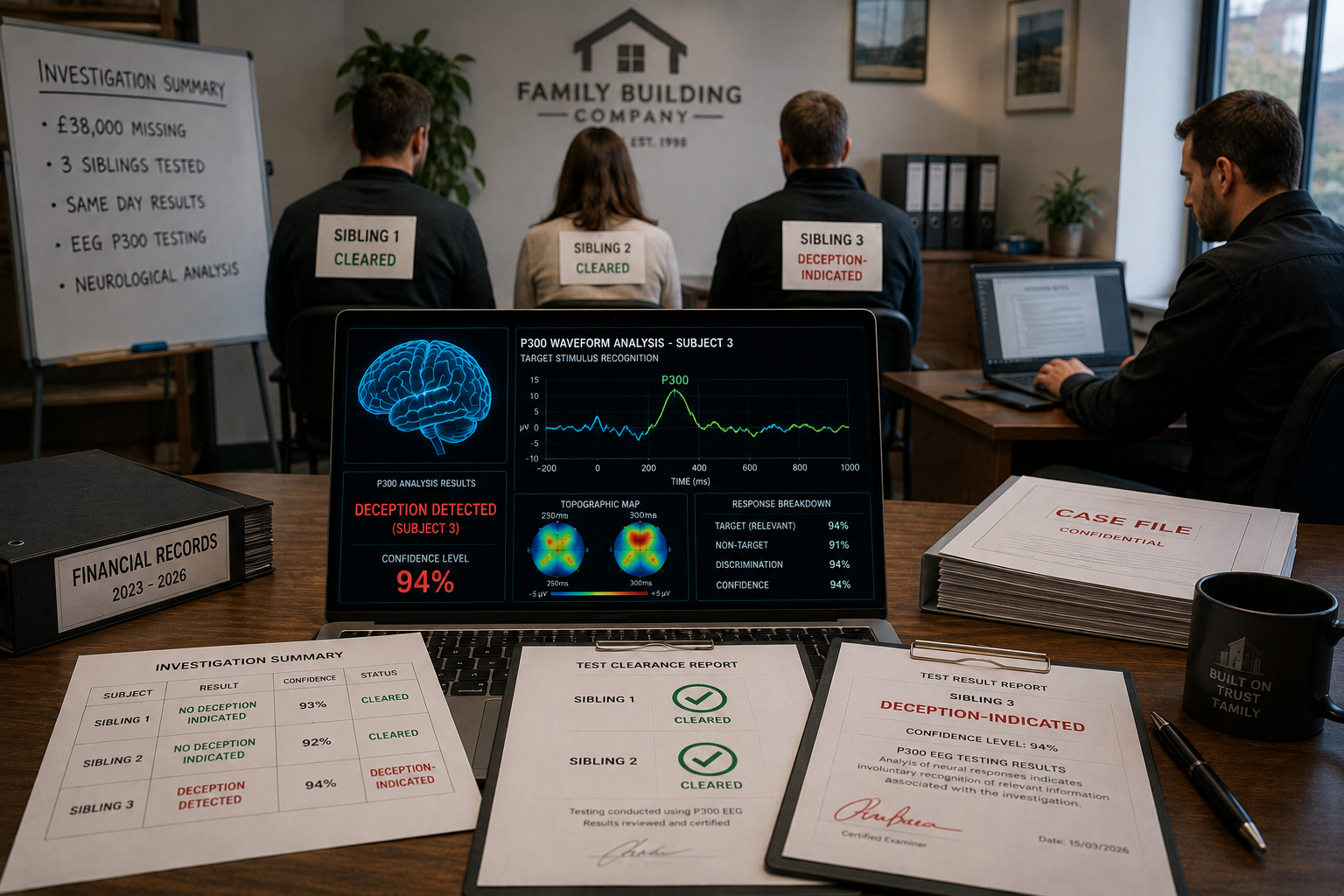
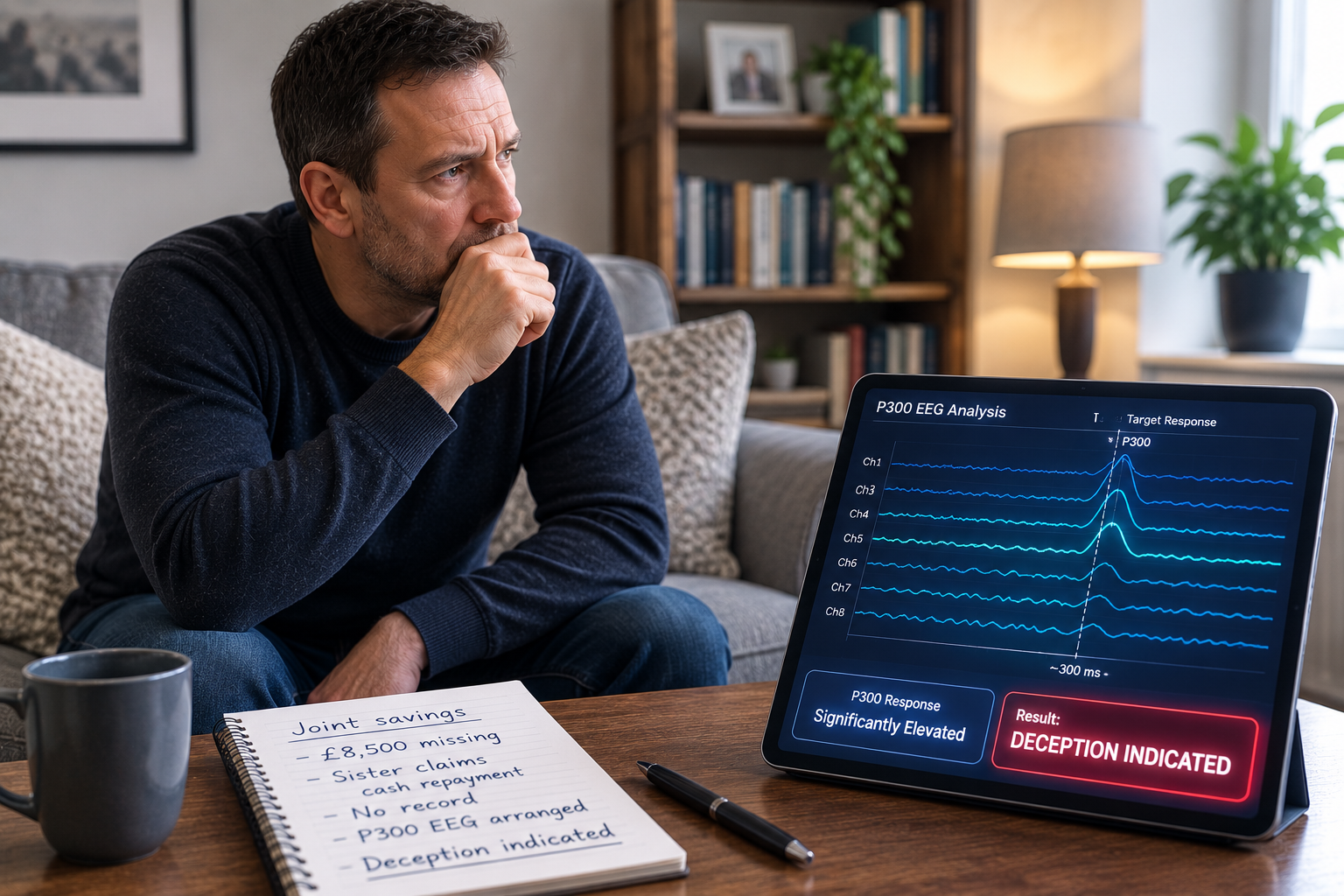
Missing Savings: A Sibling Dispute Resolved
£8,500 had gone from a joint savings account and one sister said she had repaid it in cash. The result was deception-indicated, a reminder that the test answers the question either way. The case study includes the live waveform data.
Read full case →Reviews from People Who Were Falsely Accused
Verified reviews from clients who used the test to defend themselves against a false accusation. Aggregate rating 4.9 of 5 from 499 reviews.
Accused of taking money from the till. Suspended two weeks. Took the test, took the report to HR. Investigation reopened, actual missing receipts found, I was cleared. Without the test I would have lost the job.
My partner accused me of something I had not done. Six weeks of trying to convince him I was telling the truth. Took the test, showed him the report. We are still together. The test gave him something he could trust.
Ex-wife made an allegation during separation. I had no way to prove it false. The test gave me a report I could share with my solicitor and family. The accusation eventually went away. The report was never used in court — it did not need to be.
Accused on a community WhatsApp group. The accusation took on a life of its own. Took the test, sent the report to a few people whose opinion I cared about. Narrative shifted. Most importantly, I had certainty for myself.
Bullying accusation at work — payback for a complaint I had made. Test cleared me. HR took the report seriously even though they said it was not formal evidence. Investigation closed without further action.
Accused of dishonesty in a business partnership dispute. Took the test, disclosed the report to my business partner. He took it seriously. We settled on terms that were fair. Saved months of legal fees and the partnership in the end.
Honest about the limits up front, which I appreciated. The team told me clearly what the test could and could not do. The report did exactly what they said it would. I used it with HR, it helped my case, I kept my job.
Took the test for my own peace of mind. Never showed the report to anyone. Knowing I had it changed how I carried the accusation. Eventually the situation resolved itself. I am glad I did the test.
Articles on False Accusations and Lie Detector Tests
Deeper context on how to handle a false accusation and what role a lie detector test can play.
Are Lie Detector Reports Admissible in UK Courts?
The straightforward truth: no, they are not. Here is what they are genuinely useful for instead — private clarity, HR investigations, family conversations, personal decisions.
Read article →Using a Lie Detector Report in Your HR Disciplinary Meeting
How disciplinary panels actually consider lie detector evidence in the UK — when it helps, when it does not, and how to present it.
Read article →Sharing the Test Result with Your Partner — Should You?
The pros and cons of using a lie detector report to rebuild trust in a relationship. Some couples find it transformative; for others it changes nothing.
Read article →The Psychological Toll of Being Falsely Accused
Why being doubted erodes your own certainty — and why having a piece of objective evidence can be valuable even if you never share it with anyone.
Read article →Allegations During Separation — When the Test Can Help
Separation allegations are often heightened by the emotional context. The test can give both sides a basis to step back from the worst version of events.
Read article →Defending Yourself Against an Online False Accusation
Social media accusations spread fast. Here is how to use a lie detector report selectively to shift the narrative without further inflaming the situation.
Read article →What Happens on the Day of Your Lie Detector Test
The full experience minute by minute — from the examiner's arrival, the consultation, the test itself, the on-site debrief, and the report dispatch.
Read article →Why a Polygraph Is Worse Than Useless if You Are Falsely Accused
Innocent people fail polygraphs when nervous — and being falsely accused is the most nervous state most people will ever be in. Why our brainwave test is the right tool.
Read article →Further Reading
On this site
External authoritative sources
False Accusation FAQ — the UK
The most common questions we hear from people who have been falsely accused. Tap each one to expand.
Can the lie detector test help clear my name?
Is the lie detector test report admissible in UK courts?
Can my employer take the test result seriously?
What if I take the test and the result is unclear?
What if the test shows deception when I know I am innocent?
Can I share the report with anyone I want?
Will my accuser have to take the test as well?
What if a police investigation is happening alongside the false accusation?
Can I keep the result private if I do not want to share it?
How quickly can I have the test?
What if I am too anxious to take a test?
Will the report help if the accusation has already become public?
Book your lie detector test in the UK this week. The first call is free and confidential — we will tell you honestly what the test can and cannot do for your specific situation.
Submit the booking form and an assessor calls within minutes. The first conversation is free and confidential — we will give you an honest assessment of whether the test can help your specific situation before you commit to anything.
Last updated: 27 July 2026