What a Private Investigator Can Legally Do in the UK
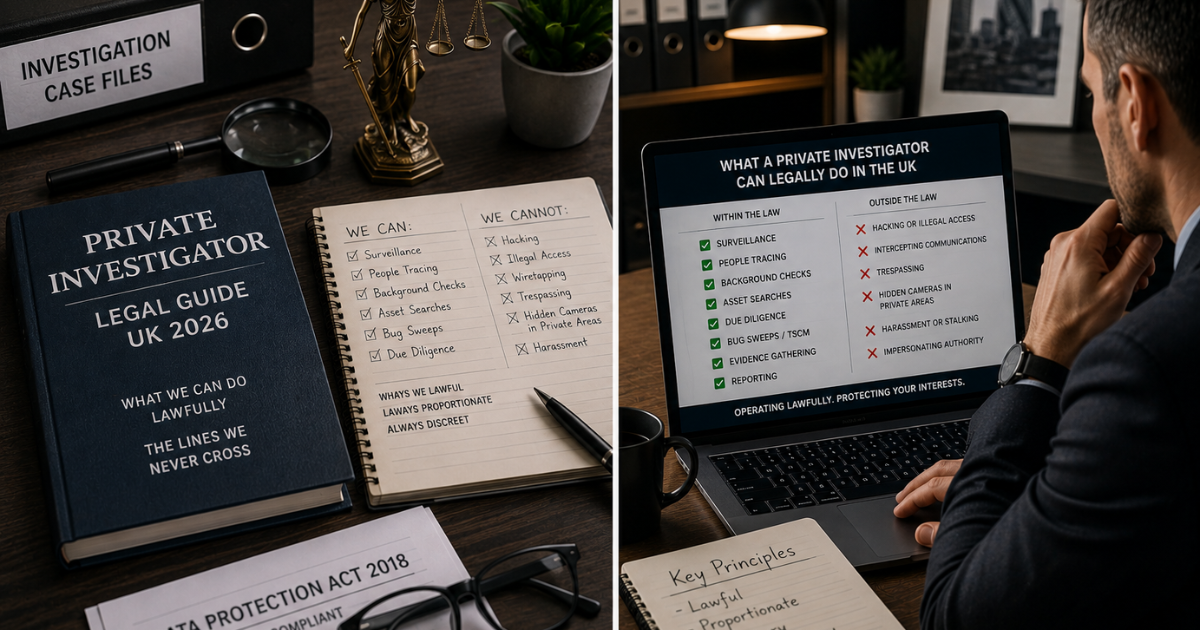
Television has given private investigation a slightly lawless reputation — all rifled bins and tapped phones. The reality is the opposite: a good investigator's value lies precisely in getting results lawfully, so the evidence holds up and the client is never exposed to risk. Here is an honest picture of where the lines sit in the UK.
Do UK private investigators need a licence?
This surprises people: at the time of writing there is no mandatory licence for private investigators in England and Wales. Licensing has been discussed for years but has not been brought into force. That makes it more important, not less, to choose an investigator who works within the law by choice — registered with the ICO for data protection, properly insured, and disciplined about how evidence is gathered.
What an investigator can do lawfully
- Surveillance in public. Observing and recording a person's activities in public places, where there is no reasonable expectation of privacy, to establish a pattern of behaviour.
- Tracing people. Locating a missing person, a debtor or a beneficiary using lawful data sources and open-source research.
- Background checks. Verifying identity and surfacing public-record information — directorships, county court judgments, insolvencies, property links — through legitimate means.
- Open-source intelligence. Gathering and analysing information that is publicly available online and in public registers.
- Process serving and evidence. Serving legal documents and preparing court-standard reports for solicitors.
What a legitimate investigator will never do
The lines an ethical investigator does not cross are as important as the work they do. Lawful investigation does not include trespassing on private property, intercepting phone calls, messages or voicemails, hacking accounts or devices, or obtaining personal data by deception — the "blagging" of records is a criminal offence. It does not include placing a tracker on a vehicle the client does not own or have authority over, which is unlawful, nor impersonating officials to extract information. Anyone offering these things is offering to put you at legal risk, not to help you.
Data protection sits over everything
All of this operates under UK GDPR and the Data Protection Act 2018. A professional investigator has a lawful basis for processing personal data, handles it proportionately, and gathers only what the case genuinely needs. That discipline is what makes the resulting evidence usable — in negotiations, in disciplinary matters, and in court.
Choosing an investigator you can trust
Because there is no mandatory licence, the burden of judgement falls on you — and a few questions sort the professional from the risky. Are they registered with the ICO and clear about their lawful basis for handling data? Are they properly insured? Will they explain, in plain terms, how evidence will be gathered and why that keeps it admissible? A credible investigator is comfortable talking about the limits of what they can lawfully do; anyone who promises phone records, account access or a tracker on someone else's car is offering to expose you to criminal liability, not to help.
If you are weighing up an enquiry, that legality is the whole point. You can read how it applies across our private investigation services, from surveillance to corporate investigations — all conducted so the findings stand up and you never do.
Investigation done properly
Discreet, lawful private investigation across the UK, with court-standard evidence and reports.
Discuss Your Case