Signs a Partner Is Cheating — and How to Know for Certain
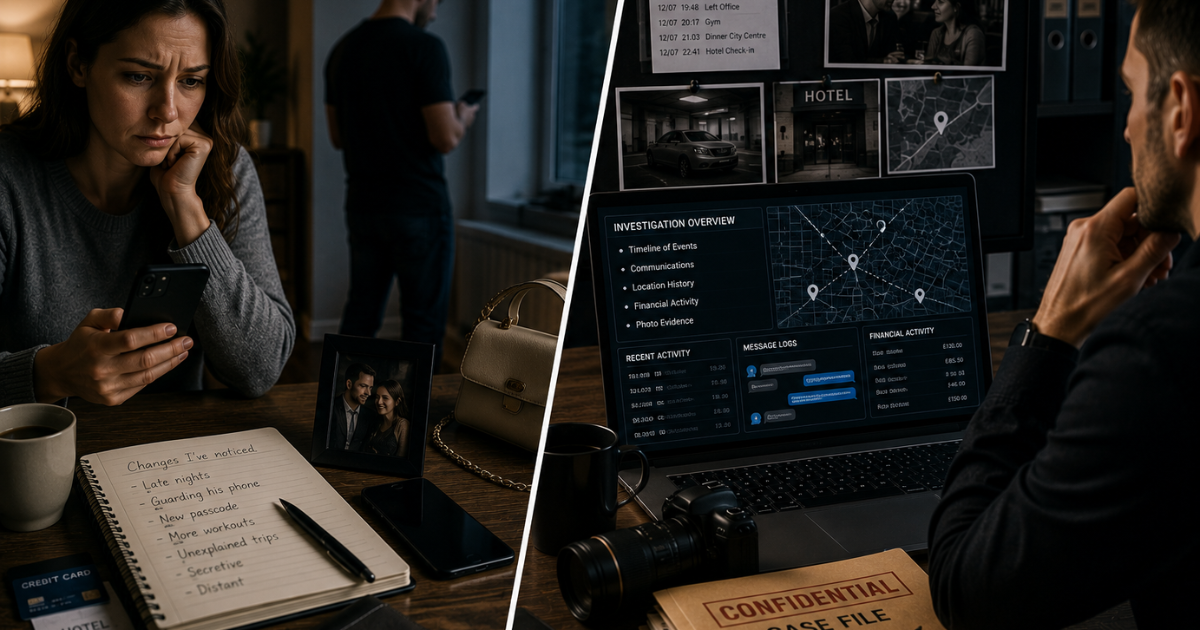
Suspecting a partner of cheating is a peculiar kind of misery. You notice things, you talk yourself out of them, and the doubt quietly rearranges how you feel about your own home. Before anything else, it is worth saying plainly: no single sign on this page proves infidelity. People change their habits for all sorts of reasons. What tends to matter is a cluster of changes, out of character, arriving together — and, in the end, whether you can replace suspicion with something you actually know.
The behavioural signs
The changes people most often describe are shifts in attention and routine. A partner who becomes newly protective of their time, vague about where they have been, or unusually irritable when asked ordinary questions. New gym habits, new clothes, a new fragrance, or a sudden interest in their appearance that has no obvious explanation. Emotional distance is common too — the sense that someone is present in the room but absent from the relationship.
The digital signs
Phones are where most modern suspicion lives. The tell-tales people report are a phone that never leaves their partner's hand, that gets turned face-down or taken into another room to answer, that has suddenly acquired a passcode it never had, or that lights up at odd hours. On their own these prove nothing — privacy is reasonable — but a sharp change from how someone used to behave is worth noticing.
The financial signs
Money leaves a trail that behaviour does not. Unexplained cash withdrawals, a second phone, hotel or restaurant spending that does not match the story you have been told, or a new subscription you cannot account for. A partner who becomes secretive about statements they were previously relaxed about is showing you a change in pattern, whatever the reason turns out to be.
Why signs are not proof — and what to do with that
Here is the honest problem. Every sign above has an innocent explanation, and acting on suspicion alone tends to make things worse: an accusation without evidence is easy to deny, poisons trust either way, and can leave you no closer to the truth. That is exactly why people reach a point where they want certainty rather than more signs. There are two lawful ways to get it.
1. Discreet surveillance
Professional cheating partner surveillance establishes what is actually happening — a pattern of behaviour documented with time and date-stamped photographic and video evidence, gathered lawfully and confidentially. It answers the question of what someone is doing, rather than what they say they are doing. If you also fear the situation has been turned around on you — that you are the one being watched or tracked — that is a separate concern our sweeps for stalking and abuse address.
2. Verification with lie detection
Where the issue is not movements but honesty — what happened, and whether an account is true — a specialist cheating partner lie detector test using P300 EEG can verify what someone says about it. Used together, surveillance and verification give you both the evidence and the confirmation in one place.
Approaching it without making things worse
If you do decide to seek certainty, a little restraint protects you. Confronting a partner on suspicion alone usually backfires — it invites denial, and it warns anyone who is hiding something to be more careful, which can make the truth harder to reach. It is calmer and more effective to decide quietly what you need to know, keep your routine normal, and let a professional gather what is needed discreetly. Whatever the outcome, you will have handled it in a way you can stand behind later.
Whichever route fits, the point is the same: you do not have to live inside the uncertainty. A clear answer — even an unwelcome one — lets you make decisions about your own life on facts rather than fear.
Stop wondering. Know for certain.
Discreet, lawful surveillance and specialist EEG lie detection — confidential from the first email.
Email in Confidence