Cheating Partner Confirmed: Client Gets Same-Day Closure
Eleven months of suspicion. Eleven months of denial. Conversations that went nowhere. Evidence that felt conclusive but proved nothing. A decision to stop guessing. One P300 EEG appointment — and by the end of the same day, Sarah had the answer she had needed for nearly a year.
Important Privacy & Sensitivity Notice
Anonymisation: All names and identifying details have been fully anonymised. "Sarah" and "Mark" are not the subjects' real names. No identifying information has been retained in this published case study.
Sensitivity: This case study documents a personal situation involving emotional difficulty and relationship breakdown. It is presented for informational purposes — to help people understand what the testing process involves and what an outcome can provide. It is not sensationalised or presented as entertainment.
Consent: The subject in this case provided full informed written consent before the session. P300 EEG testing is never conducted without the explicit consent of the person being tested.
Background
"Sarah" (anonymised, early forties, Greater Manchester) had been in a relationship with her partner "Mark" for twelve years. The relationship had been stable and, from her perspective, settled — until around November 2024, when she began noticing changes in his behaviour that she could not account for. The changes were individually unremarkable. In combination, over the months that followed, they became impossible for her to ignore.
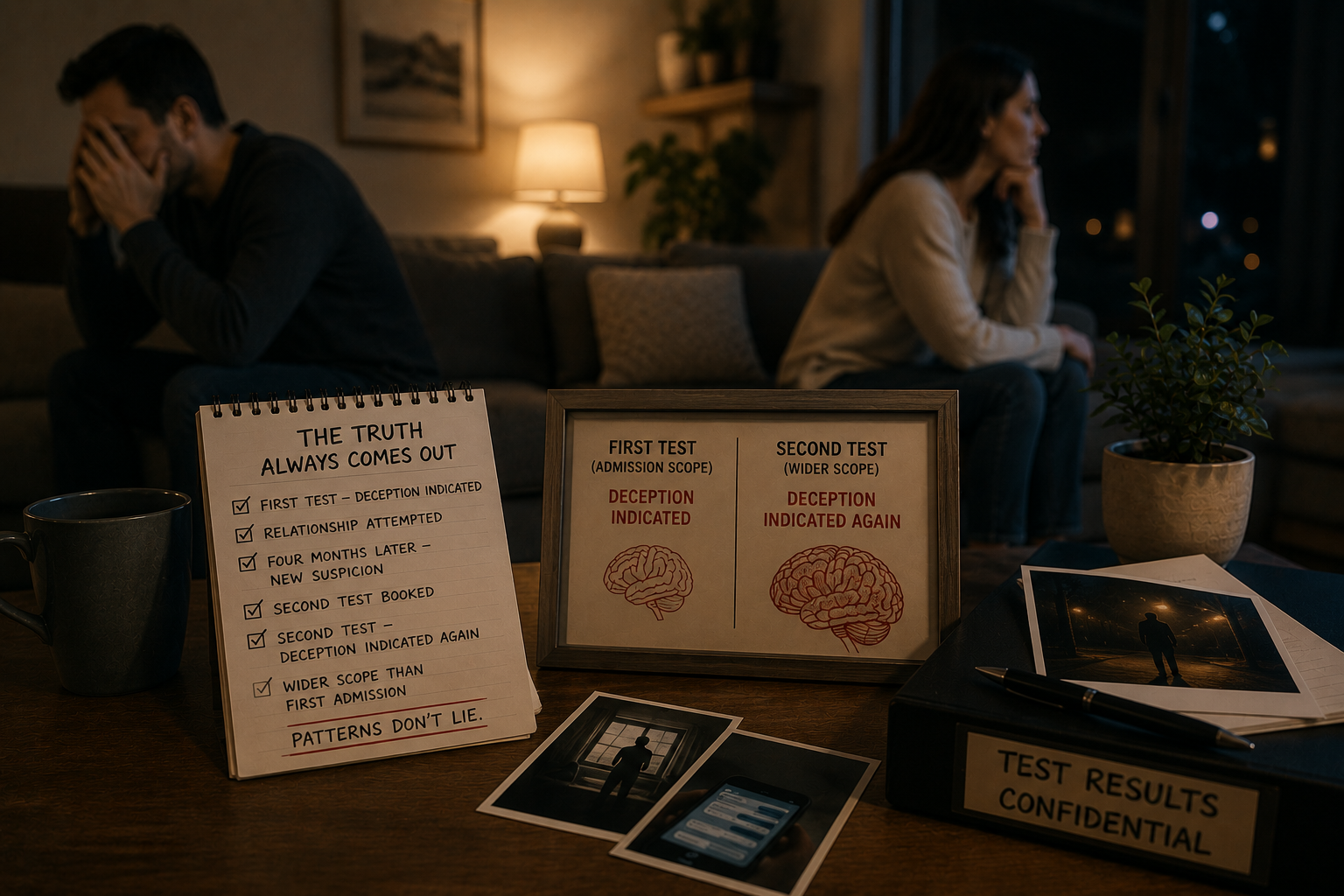
She raised her concerns with Mark multiple times across the following months. Each conversation followed the same pattern: he denied everything, attributed her concerns to stress or insecurity, and the conversation ended without resolution. By the time she contacted us in October 2025, she had been living with the uncertainty for eleven months. She described it as worse than knowing the truth would be — not because she was certain he had been unfaithful, but because she could not be certain he hadn't been.
Mark agreed to take the P300 EEG test. His stated reason was that he wanted to prove her wrong. He attended the appointment without advance preparation and gave no indication of reluctance during the pre-session briefing.
What eleven months of uncertainty actually costs
The state Sarah was in before the test — and after it
Before — living in uncertainty
- Constantly second-guessing her own perception of events
- Unable to make decisions about the relationship's future
- Each denial from Mark left her more isolated, not less
- Sleep disrupted, concentration affected at work
- Could not confide fully in friends without feeling disloyal
- Alternating between conviction and self-doubt
After — living with a clear answer
- Could trust her own perception — it had been right
- Had documented, objective evidence, not just a feeling
- Could make a clear decision about what to do next
- The psychological burden of uncertainty was resolved
- Could speak to friends and family with full information
- Moved from paralysis to decision within a week
What Prompted the Investigation
We are publishing this section at a level of detail sufficient to help people recognise their own situations — without reproducing the specific personal details of this case, which would serve no purpose and which Sarah has not consented to share publicly.
The pattern she had observed over eleven months was consistent with the behavioural profile we see in the majority of infidelity referrals. Changes in phone use and privacy. Unexplained gaps in availability. Shifts in emotional engagement at home — not dramatic, but consistent, in a direction. An increased frequency of working commitments that didn't match the usual pattern of his role. A change in how he responded when she raised concerns — no longer dismissive in the way she had previously found reassuring, but careful in a way that felt different.
None of these individually constituted evidence of anything. Together, across eleven months, they had become the background noise of her daily life — present in every interaction, impossible to resolve through conversation, and not reducible to a simple confrontation. She had reached the point where continuing to live with the uncertainty was more damaging than knowing the answer.
Why she chose P300 EEG over other options
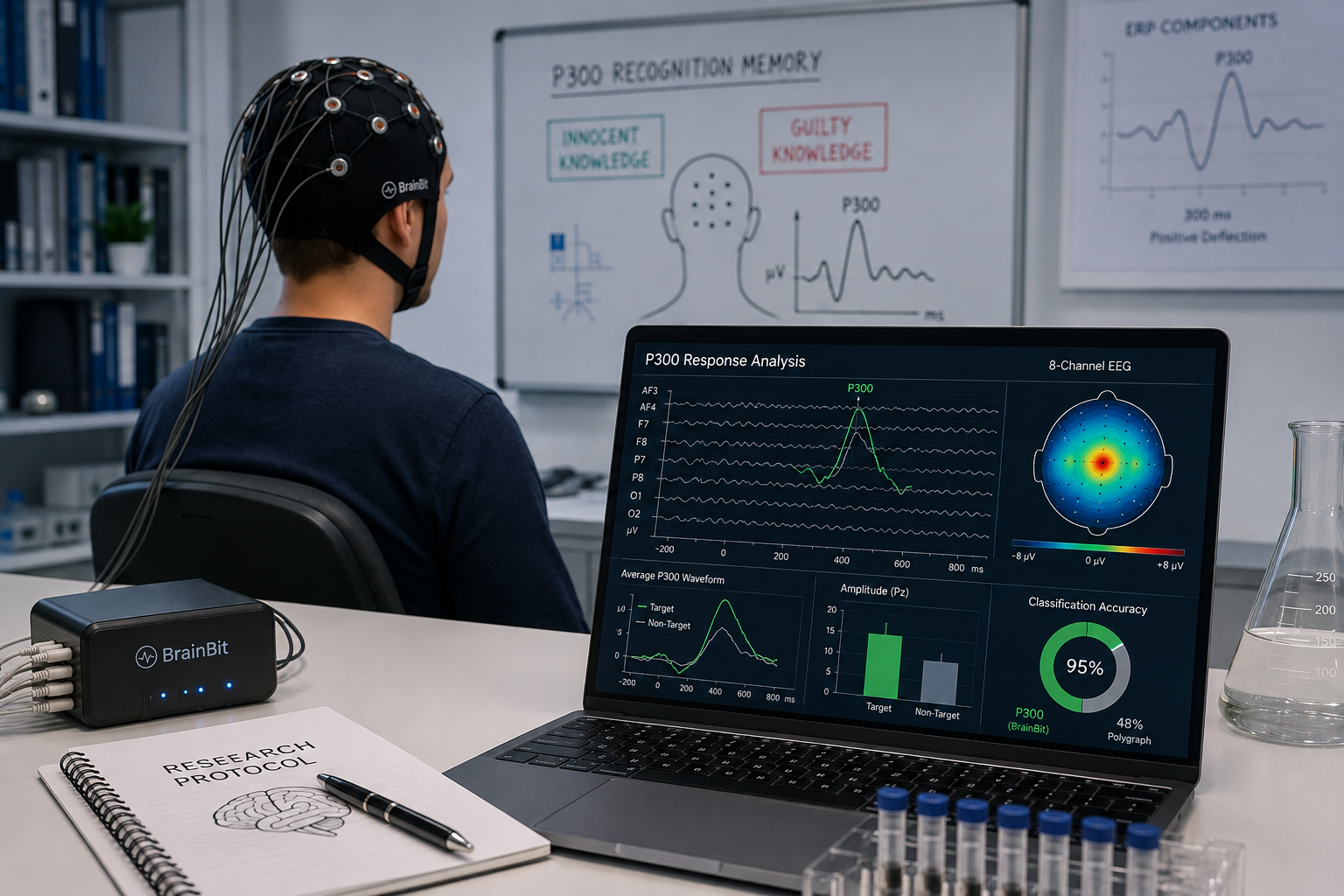
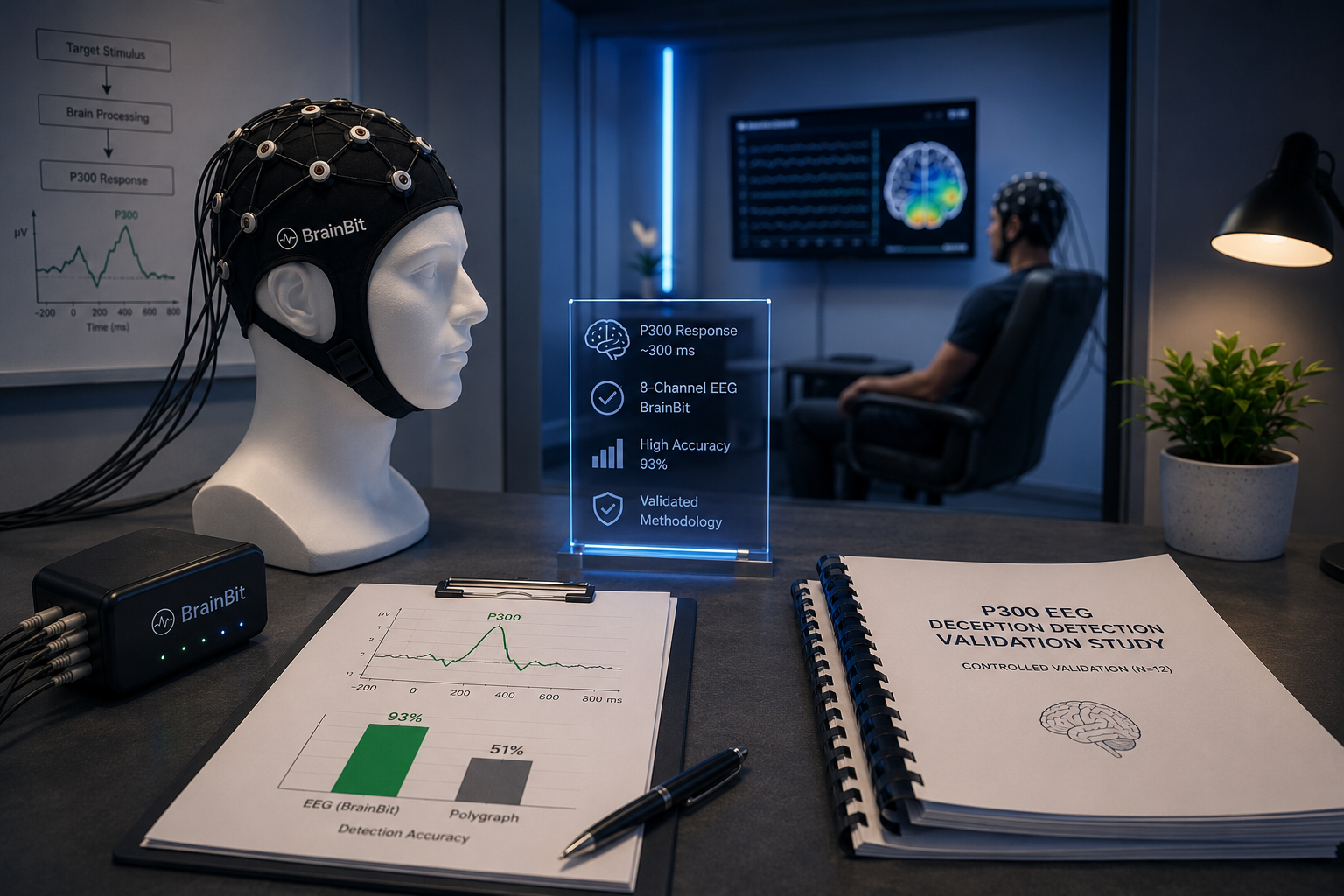
- Accuracy: She had read about polygraph testing and was not confident in its reliability. The 95% accuracy of P300 EEG versus 51% for polygraph was the deciding factor in choosing this method.
- The same-day result: She had been waiting eleven months. She could not face the prospect of booking a test and then waiting days for a result. Same-day verbal result was essential to her decision to proceed.
- Objectivity: She needed something that was not a conversation, not an interview, and not dependent on how convincing either of them was. A neurological test measuring what his brain recognised was the most objective thing available.
- The written report: She wanted documentation — something she could refer back to, something that had not been produced by either of them, something that existed independently of both their accounts.
Test Design
The probe design for an infidelity case differs from corporate fraud investigations in one important respect: the information available to build specific probe stimuli is limited by what the booking client knows or suspects, rather than by documented records. The probe design in this case was built through an initial consultation with Sarah in which she described the specific circumstances of her suspicions — without any leading from us about what the probes would contain.
Probe Set 1 — Relationship-specific recognition
Stimuli built around specific details of the suspected involvement — places, contexts, and circumstances described by Sarah — that would only be neurologically familiar to someone who had been present in those specific situations. The design distinguishes between recognition of the details as described versus the general familiarity a committed partner would have with their daily life.
Probe Set 2 — Deception and concealment knowledge
Stimuli built around the specific mechanisms Mark had used to manage the unexplained gaps in availability — details that Sarah had described from her own observations, which formed the basis of specific probe stimuli. Only someone who had actively managed a concealment would hold these operational details in neurological memory in the specific form the probes tested.
Probe Set 3 — Denial-specific knowledge
Stimuli built around specific aspects of the denial conversations between Sarah and Mark — particular phrases, specific moments, specific denials made in specific contexts. A person who had genuinely been telling the truth across those conversations would hold them in memory in a different neurological form from someone who had been constructing false denials.
Probe Set 4 — General relationship baseline
Control probe set using general relationship details that both Sarah and Mark would hold consistently — shared memories, confirmed events, information both parties had full access to. Used to establish a reliable baseline for Mark's recognition responses before assessing the results of the three specific probe sets.
Pre-session briefing (20 minutes)
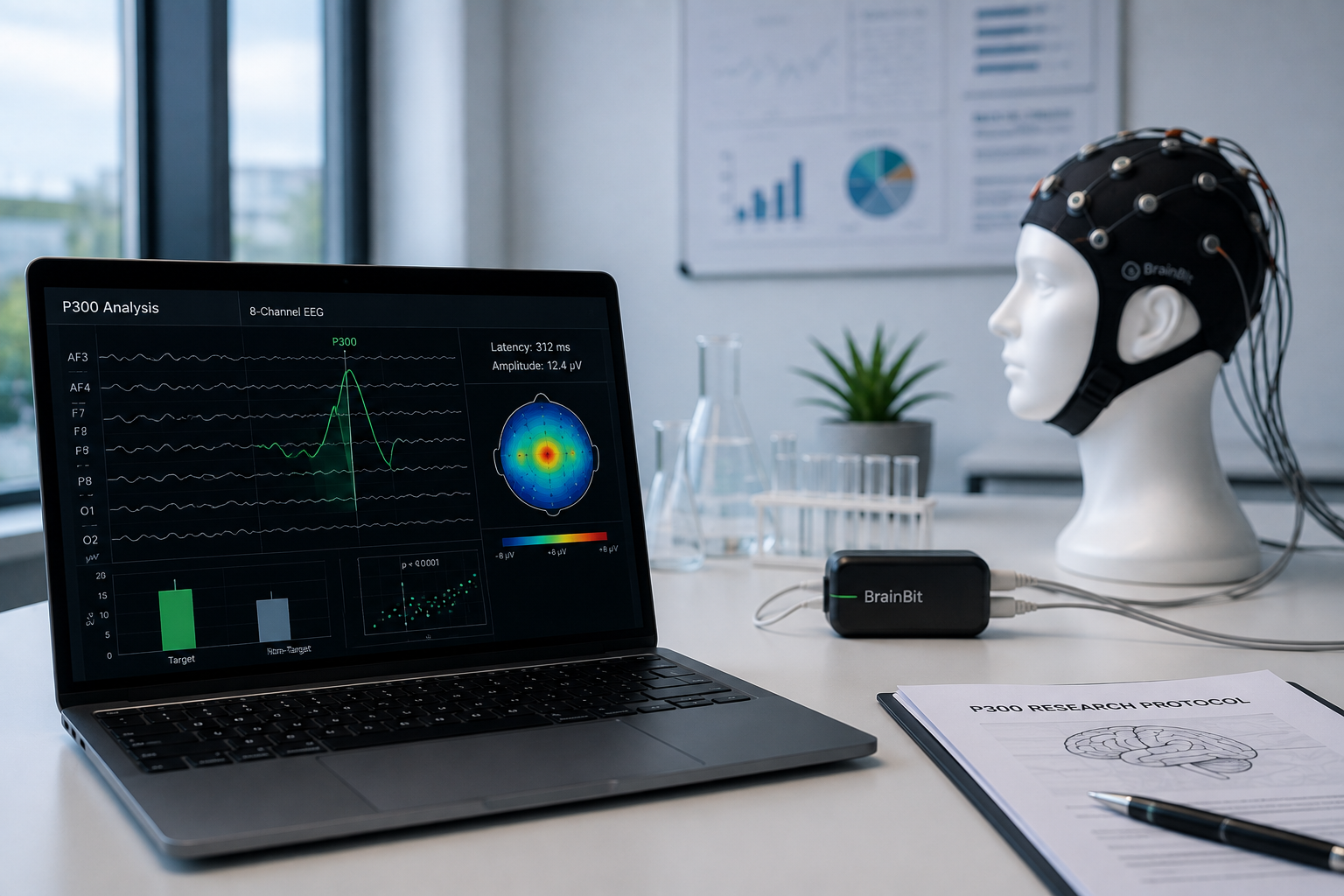
Mark was briefed on the P300 EEG process — the headband, the screen stimuli, the button responses. He was told the test concerned the relationship concerns Sarah had raised. He was not told the specific probe stimuli. He consented in writing and gave no indication of reluctance to proceed.
Baseline calibration (10 minutes)
Standard baseline established Mark's individual P300 amplitude and latency parameters. His baseline was clean and well-defined — making the probe results straightforward to interpret against his own neurological baseline.
Four probe set sessions (60 minutes)
All four probe sets delivered sequentially with standard rest intervals. The session was calm throughout. Mark appeared relaxed and showed no visible signs of anxiety. As documented across other case studies, surface composure has no effect on P300 EEG results.
Same-day verbal result — end of session
Sarah was waiting separately. The verbal result was delivered to her privately at the close of the session — before she and Mark had any post-session contact. She received the result alone, with time to process it before any subsequent conversation.
Results
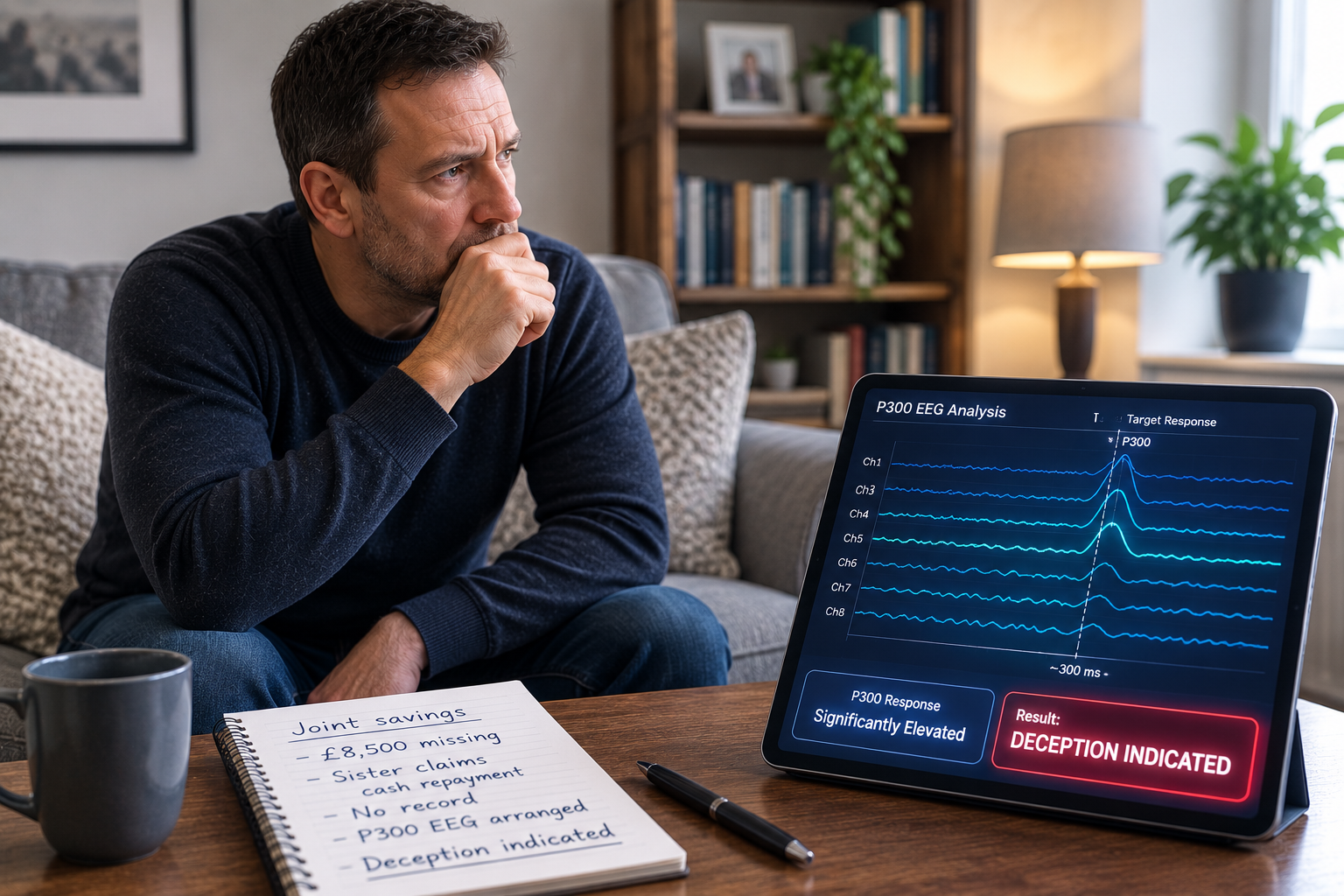
The clear result on Probe Set 4 is important. It confirms that the P300 recognition responses on the first three probe sets were not the result of generalised anxiety, emotional arousal, or the fact of being tested in a charged personal context. Mark produced the expected baseline responses on the general relationship content — and produced recognition responses on the specific infidelity-related content that go substantially beyond what innocent general relationship knowledge would produce.
What a P300 EEG result can and cannot do
A deception-indicated result confirms that the subject holds specific neurological knowledge of the details the probe design was built around. It does not tell you the full scope of what happened, when it started, how long it continued, or anything that the probe design did not specifically test for.
It cannot make a decision for you about your relationship or your future. What it can do — and what it did for Sarah — is replace uncertainty with a documented, objective answer. Whether to stay, whether to leave, how to respond, what to say — these remain decisions that belong to you. The test provides the factual foundation for making them clearly rather than through fog.
Sarah was told this before the appointment, and she was told it again when the result was delivered. The result resolved her uncertainty. The decisions about what to do with it were hers.
Key Findings
- Deception-indicated results on three of four probe sets — covering the specific infidelity-related knowledge, the concealment mechanics, and the denial-specific memory — confirmed that Mark held neurological knowledge of the events Sarah had suspected.
- The clear result on the baseline control probe set confirmed the probe design had worked correctly — Mark's brain distinguished between general relationship knowledge (clear) and the specific concealed knowledge being tested (deception indicated).
- Mark had attended presenting as relaxed and confident, having stated he would be proven innocent. Surface composure produced no effect on the neurological results.
- The verbal result was delivered to Sarah privately on the same day, giving her the opportunity to process the result before any subsequent contact with Mark.
- Within one week of receiving the written report, Sarah had made a clear decision about her relationship and begun taking practical steps forward — ending eleven months of paralysis.
What Closure Actually Looked Like
The concept of "closure" is often used loosely. In this case it had a specific practical meaning: Sarah could make a decision. For eleven months she had been unable to act because she could not be certain enough. The test provided that certainty — not as a matter of opinion, but as a documented neurological finding that existed independently of both her and Mark's accounts.
On the day of the test, Mark admitted the infidelity after being informed of the result — something eleven months of conversations had not produced. The written report gave Sarah something she had not had before: an objective document she could refer to without it being subject to his denial or her doubt.
She subsequently described the test appointment as the first day in eleven months that she had felt clear-headed about her situation. Not happy — the result was not what anyone hopes for — but clear. The distinction matters. She described the eleven months before the test as harder to live through than the days immediately after it, because at least after it she knew what she was dealing with.
Why People in This Situation Choose Testing
Conversations without resolution are not a path to certainty
A partner who has been unfaithful and is determined to deny it will continue denying it through any number of conversations. Confrontations produce the same result each time — denial, deflection, and the return to uncertainty. The only thing that can break this pattern is objective evidence that exists outside the dynamic of the two people involved. P300 EEG produces that evidence. It does not ask the partner what they did. It tests what their brain holds — and that is not something they can manage through denial.
The same-day result matters more than people expect
People who have spent months in uncertainty are often affected by the prospect of additional waiting as much as by the test itself. The same-day verbal result in this case was not incidental — it was the thing that allowed Sarah to act. Having an answer at the end of the day rather than after further days of waiting made the entire experience qualitatively different from the months she had already endured. It also meant that Mark had no intermediate period in which to prepare a counter-narrative before she had the full picture.
The written report has value beyond the immediate result
A written report documenting a deception-indicated result — with raw waveform data, probability scores, and examiner conclusions — is not the same as a verbal result or a personal conviction. It can be shown to a solicitor, used as supporting context in legal proceedings where relevant, referred to by friends or family who need to understand the situation, and retained as a documented record that cannot be revised by either party over time. Several clients have described the written report as important not for any legal use but because it gave their own knowledge the status of a fact rather than a belief.
Living With Suspicion You Can't Resolve?
Verbal result the same day. Written report within 24 hours. Confidential consultation — no obligation to book.