Insider Threats: How Businesses Uncover Fraud and Leaks
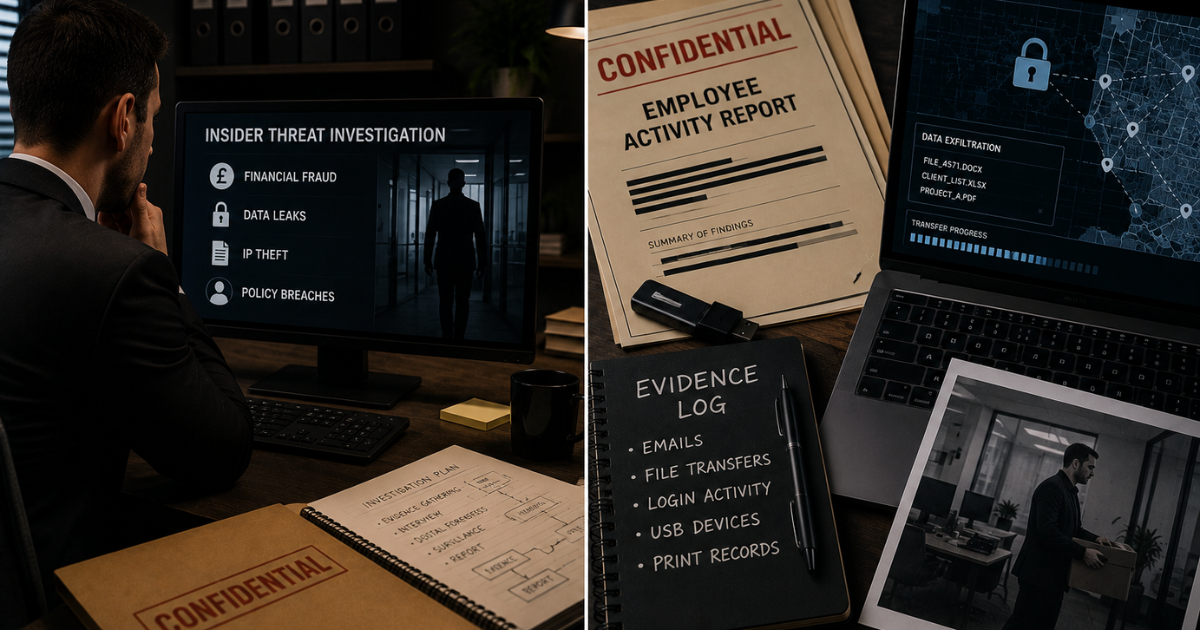
The threats that cost businesses most rarely come through the front door. They come from inside — a trusted employee, a departing director, a supplier with access. Insider incidents are harder to see precisely because the person already belongs, and by the time the damage is obvious, the money, the data or the advantage has usually already gone. Knowing how these things surface is the first step to catching them.
The threats businesses actually face
- Financial fraud. False invoicing, expense manipulation, procurement kickbacks and skimming — often small enough to hide, sustained enough to hurt.
- Data and IP theft. Confidential files, client lists and designs walking out with someone — frequently around the time they leave for a competitor.
- Leaks. Sensitive strategy or negotiating positions reaching the other side, sometimes through a person, sometimes through a device left in the room.
- Misconduct and false claims. Grievances, absence abuse and conduct issues where the truth is contested and the stakes are high.
How they get uncovered
Corporate investigation
Most insider cases are resolved by patient, lawful fact-finding: corporate investigation that follows the paper trail, verifies identities and relationships, conducts discreet due diligence, and — where justified — lawful surveillance to establish what is actually happening. The aim is evidence a business can act on through HR, disciplinary and legal channels, gathered so it stands up to challenge.
Counter-surveillance sweeps
When the concern is a leak rather than a person's conduct, the question changes: is something in the room listening? An office and boardroom bug sweep checks meeting rooms and executive offices for covert listening devices and cameras, using radio-frequency and physical detection. Businesses commonly commission one before sensitive negotiations, during a dispute, or after a senior departure — the moments when a leaked word is worth the most.
Discretion is the whole game
An insider investigation that tips off its subject can be worse than none at all — evidence disappears and the trail goes cold. That is why this work is planned to be invisible: sweeps run out of hours, enquiries stay confidential, and findings go only to the people who need them. Handled that way, a business replaces suspicion with fact and can act decisively, whether that means a quiet conversation, a disciplinary process, or the police.
The early warning signs for a business
Insider problems tend to announce themselves quietly before they become obvious. A supplier or process that only one person is ever allowed to handle. Reluctance to take leave, because time away means someone else would see the books. Margins or stock that drift without a clean explanation. A competitor who seems to anticipate your moves. An employee whose lifestyle outpaces their salary, or one heading for the exit who suddenly takes an unusual interest in files and contacts. None of these proves wrongdoing — but a cluster of them is a prompt to look properly rather than hope.
If something does not add up — a competitor a step ahead, numbers that will not reconcile, a departure that leaves questions — the sooner it is looked at properly, the more there is to find.
Protect the business with facts
Confidential corporate investigation and counter-surveillance sweeps, arranged around your operations.
Discuss in Confidence